A group of four coworkers stood on the first tee at a charity tournament, three of them having never broken 100. By the final hole, they'd carded a 12-under-par round and couldn't stop grinning. That's the magic of a scramble. So what is a golf scramble, exactly? It's the most popular team format in recreational and tournament golf — a structure where every player hits, the team picks the best shot, and everyone plays from that spot. It levels the playing field, speeds up play, and makes golf genuinely fun for all skill levels and formats. Whether organizing a corporate outing or joining a weekend fundraiser, understanding the scramble format is essential knowledge for any golfer.

The scramble format has become the default choice for charity events, company outings, and casual tournaments across the country. Its appeal is straightforward: nobody gets left behind, every player contributes, and the pace stays brisk. Even scratch golfers enjoy scrambles because the team dynamic creates a completely different strategic challenge than individual stroke play.
This guide breaks down exactly how a golf scramble works, the rules that govern play, strategies for building a winning team, common mistakes to avoid, and practical tips that separate the contenders from the casual participants. Whether a first-timer or a scramble veteran looking to sharpen the edge, everything needed to compete confidently is right here.
Contents
How a Golf Scramble Works Step by Step
Understanding what is a golf scramble starts with the basic flow of play. The format is deceptively simple on the surface, but each phase has nuances that affect scoring.
Tee Shot Selection
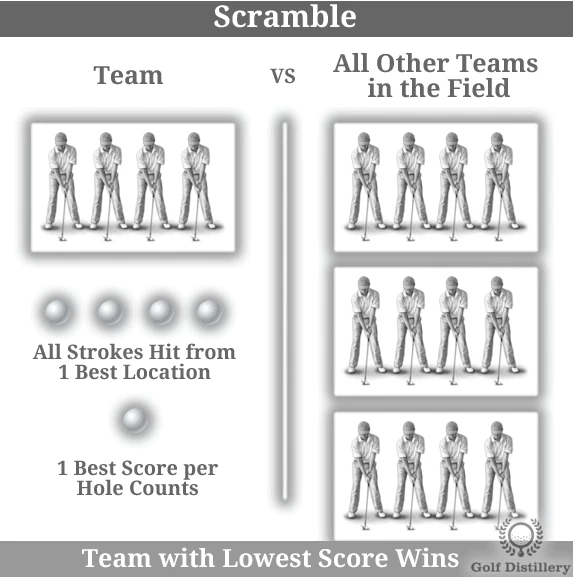
Every player on the team (typically four, sometimes two or three) tees off on each hole. After all drives land, the team evaluates and selects the best tee shot. "Best" doesn't always mean longest — position, lie quality, and angle to the pin all factor into the decision.
- All players hit from the teeing ground
- The team walks or drives to each ball and compares results
- One shot is selected based on distance, accuracy, and lie
- All other balls are picked up
- Each player places their ball within one club length of the chosen spot (no closer to the hole)
Approach and Short Game Play
The process repeats for every subsequent shot. All four players hit from the chosen location, and the team again selects the best result. This cycle continues through approach shots, chips, and pitches until the ball reaches the green. Short game shots often prove more valuable than booming drives — a well-placed chip can save a hole that a wayward approach nearly ruined.
Pro Tip: The most undervalued skill in a scramble isn't the 300-yard drive — it's the player who can consistently land a chip within 6 feet of the pin when the team's approach shots miss the green.
The Putting Process
On the green, the same selection process applies. All players putt, and the team takes the best result. A common strategy is to have the first putter play aggressively to establish a read and speed reference. Subsequent putters adjust accordingly. Once any ball drops, the hole is complete.
Official Scramble Rules and Variations
While the scramble format isn't governed by the USGA as an official format, most tournaments follow a consistent set of rules. Knowing these prevents penalties and disputes on the course.
Standard Rules
- Ball placement: Within one club length of the selected shot, no closer to the hole, in the same condition (fairway stays fairway, rough stays rough)
- Tee shot minimums: Many tournaments require each player's drive to be used a minimum number of times (typically 2–4 times per round)
- Putting placement: On the green, balls are placed within one putter-head length of the selected mark
- Hazards: If the selected shot is in a bunker, all players must play from the bunker
- Order of play: Any player may go first — there's no requirement to follow traditional "away" rules
Popular Variations
Tournament organizers frequently modify standard scramble rules to adjust difficulty or add excitement. Here are the most common variations:
| Variation | Rule Modification | Effect on Score |
|---|---|---|
| Texas Scramble | Each player's drive must be used at least 4 times | +3 to +6 strokes |
| Florida Scramble | Player whose shot is selected sits out the next shot | +4 to +8 strokes |
| Bramble | Best drive selected, then individual play to hole out | +8 to +15 strokes |
| Las Vegas Scramble | A die roll determines which drive is used | +6 to +12 strokes |
| Step Aside | Player whose shot is chosen cannot hit the next shot | +4 to +7 strokes |
The Texas Scramble is the most common variant for competitive events because the drive minimum requirement prevents teams from relying solely on one long hitter. Knowing which variation applies before tee time is critical for developing the right strategy.

Building a Winning Scramble Team
Team composition matters more than raw individual talent in a scramble. A team of four 10-handicappers with complementary skills will regularly beat a team with one scratch golfer and three beginners.
The Ideal Roster Breakdown
The strongest scramble teams cover four distinct roles. Each role addresses a specific scoring need:
- The Bomber: A long, reasonably accurate driver who consistently reaches par 5s in two and shortens par 4s. This player's drives set up scoring opportunities.
- The Iron Specialist: Someone who hits greens in regulation at a high rate. Approach accuracy is arguably the most important skill in scramble golf.
- The Short Game Wizard: A player who excels at chipping, pitching, and bunker play. This person rescues the team when approach shots miss.
- The Putter: A confident, steady putter who thrives under pressure. Choosing the right putter and having someone who can drain the 8-footers is what separates winning teams.

Role Assignments
Smart teams assign roles before the round, not on the fly. The bomber always hits first off the tee to establish a safety drive. The steadiest putter always goes last on the green. Middle players adjust based on the situation — if the team is safely on the fairway, the iron specialist can swing aggressively at the pin rather than playing safe.
Teams should also discuss risk tolerance before the round. Agreeing in advance on when to play aggressive versus conservative eliminates on-course arguments and indecision that waste both time and strokes.
Scramble Strategy That Actually Works
Knowing what is a golf scramble and actually winning one are two different things. Strategy separates teams that card 15-under from those stuck at 5-under.
Tee Box Order
The order players tee off in directly impacts scoring. The optimal sequence follows a risk-management model:
- Safety first: The most consistent player tees off first, putting a ball in play to relieve pressure
- Mid-range hitters: Second and third positions can swing with moderate aggression, knowing a safety ball exists
- The bomber: Hits last and swings freely, knowing the team already has a ball in the fairway
This order applies primarily to tee shots. On approach shots, the sequence often reverses — the most aggressive player goes first to establish a target line, while safer players clean up if needed.
Warning: Never let all four players swing for the fences on the same shot. At least one player should always play the conservative line — a team without a ball in play turns a birdie hole into a scramble for bogey.
Risk Management on the Course
Effective scramble teams play a probability game. Once a safe shot is established, remaining players can take calculated risks:
- Par 3s: First player aims center-green. Others fire at the pin.
- Par 5s: If the team has a solid layup position, one player should always go for the green in two.
- Risky pins: Tucked pins behind bunkers or water should only be attacked after a safe ball is on the green.
- Putting reads: The first putter serves as the scout — play the putt at pace to see the break, even if it doesn't drop.
Pace of play is also a strategic factor. Scrambles notoriously slow down when teams deliberate too long over shot selection. Set a 30-second decision rule and stick to it. Faster decisions lead to better rhythm, which leads to better shots. Understanding how long 18 holes should take helps teams maintain appropriate pace without holding up the field.

Gear and Preparation for Scramble Day
Scramble tournaments don't require different clubs, but they do demand different preparation. The focus shifts from well-rounded individual play to maximizing each player's strengths.
Club Selection Priorities
Since each player fills a specific role, club selection should emphasize that role's demands. Teams don't need four identical bags — they need four complementary ones.
- The Bomber: Carry a driver optimized for distance. Consider a 3-wood for tight par 4s. Fewer wedges are acceptable since short game specialists cover that gap.
- The Iron Specialist: Full iron set is essential. Consider carrying a hybrid for long approach shots into par 5s and lengthy par 3s.
- The Short Game Player: Three or four wedges with varying bounces and lofts. A 48°, 52°, 56°, and 60° setup covers every scenario from 120 yards in.
- The Putter: Bring a putter that inspires confidence. This is not the day to test new equipment on the green.
Practice Focus Areas
In the days before a scramble, individual practice should target each player's assigned role rather than general improvement. The bomber should hit drivers exclusively. The short game specialist should focus on chips and pitches from 40 yards and in. General golf improvement practices still apply, but the immediate goal is sharpening the specific skill the team needs most.
Teams that practice together — even one range session — outperform teams that meet on the first tee. Walking through shot-selection decisions, establishing putting order, and agreeing on hand signals for on-course communication all pay dividends during the actual event.
Mistakes That Cost Scramble Teams Strokes
Most scramble teams leave 5–10 strokes on the course due to avoidable errors. Recognizing these patterns is the fastest path to lower scores.
Strategic Errors
- Always choosing the longest drive: Distance is useless from the wrong angle. A shorter drive in the center of the fairway with a clear approach often produces better results than a bomb into the rough with a tree in the way.
- Ignoring the lie: A ball sitting down in the rough is harder to advance than one sitting up in the first cut. Factor lie quality into every shot selection.
- Playing too conservatively: Scrambles reward aggression — but only calculated aggression. Teams that never attack pins rarely break 10-under, and that's not competitive in most fields.
- Poor putting strategy: Sending all four players at the same line wastes opportunities. If the first putt reveals the break, subsequent putters should adjust — not repeat the same miss.
- Neglecting the drive minimum: Saving required drives for the last few holes forces the team to use weak drives on critical finishing holes. Burn them on easier holes early.
Team Dynamic Pitfalls
The human element derails more scramble teams than bad swings. These interpersonal mistakes are as costly as any strategic error:
- No designated captain: Someone must make the final call on shot selection. Democracy on the golf course leads to indecision and slow play.
- Discouraging teammates after bad shots: In a scramble, bad individual shots are irrelevant — the team only needs one good one. Keep energy positive.
- Overserving at the beverage cart: Scrambles are social, but teams that treat the event as a party first rarely contend. Save the celebrations for the 19th hole.
- Uneven effort: Every player's shot matters, including the weakest player's. That high-handicapper's drive might be the one the team needs to meet the minimum requirement.
Scramble vs. Other Team Formats
The scramble is the most accessible team format, but it's not the only option. Understanding how it compares to alternatives helps organizers choose the right structure and helps players adapt their approach for each format.
Format Comparison
| Feature | Scramble | Best Ball | Alternate Shot | Chapman/Pinehurst |
|---|---|---|---|---|
| Team Size | 2–4 players | 2–4 players | 2 players | 2 players |
| Individual Skill Required | Low | Medium | High | High |
| Pace of Play | Fast | Moderate | Fast | Moderate |
| Beginner Friendly | Very | Moderate | Low | Low |
| Strategy Depth | Moderate | Low | High | High |
| Typical Use | Charity/corporate | Club events | Ryder Cup style | Member-guest |
| Handicap Impact | Minimal | Significant | Critical | Significant |
When to Choose Each Format
Scrambles work best when the field includes a wide range of skill levels, when pace of play is a priority, or when the goal is maximum fun and participation. Four-ball (best ball) golf offers a step up in individual accountability while still maintaining a team dynamic. Alternate shot formats test partnerships deeply but can frustrate less experienced players who feel responsible for poor holes.
For charity and corporate events, the scramble remains the clear winner. It keeps everyone engaged, creates natural conversation opportunities between shots, and ensures no single player's bad hole ruins the experience for the group. Competitive club events benefit from best ball or Chapman formats that balance teamwork with individual performance.
Frequently Asked Questions
How many players are on a scramble team?
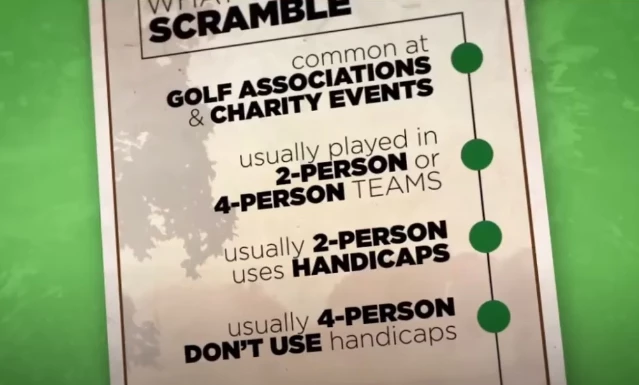
Most scramble tournaments use four-player teams, though two-person and three-person scrambles also exist. Four-player teams are the standard for charity and corporate events because they maximize participation and create the most dramatic scoring. The format works with any team size, but strategy and scoring expectations change significantly with fewer players.
What is a good score in a four-person scramble?
Competitive four-person scramble teams typically shoot between 15 and 20 under par on a standard par-72 course. Casual or mixed-skill teams generally card scores between 8 and 14 under. Anything below 20 under usually requires at least two low-handicap players and strong putting throughout the round.
Can handicaps be used in a scramble?
Many tournament organizers apply handicap adjustments to level the playing field. The most common method takes a percentage of each player's handicap — typically 20% of the lowest handicap, 15% of the second, 10% of the third, and 5% of the highest. These percentages vary by event, so checking the specific tournament rules beforehand is essential.
What is the difference between a scramble and best ball?
In a scramble, all players hit from the same chosen spot after each shot. In best ball (also called four-ball), each player plays their own ball for the entire hole, and the team records the lowest individual score. Best ball requires stronger individual play, while scrambles emphasize team collaboration and shot selection strategy.
Are mulligans allowed in a scramble?
Mulligans are not part of the official scramble format, but many charity and fundraiser tournaments sell them as a way to raise additional money. When allowed, mulligans typically cost between $5 and $25 each, with a limit of one to three per player per round. Competitive scramble events rarely permit mulligans.
A golf scramble turns four imperfect games into one great round — the format where every golfer contributes, nobody gets left behind, and the team always plays its best.



About Bill Winters
Those who have not yet tried the sport just can’t imagine what is driving these golfers to brave the sun’s heat and go around a course bigger than several football fields combined. It seems like an awful lot of work considering that the ball is quite small that is must be hard to hit, the ground of the course is not flat and, most annoying of all, there are sand traps lying around seemingly bent on preventing a player from finishing the course.
Follow & Subscribe for more:


About the Author

The game of golf may seem like an awful lot to take on when one considers that the ball is quite small, must be hard to hit and carry through windy conditions with little chance for error. The ground course has hillsides which make it challenging enough without adding sand traps who seem bent on preventing players from completing their round!
Get the FREE Gifts now. Or receive the latest golf eBooks for free from our bestselling.
Disable Ad Block to reveal all the secrets. Once done, hit a below button: