The first time you pure a golf ball — dead center, zero fade, zero draw — it barely makes a sound. That quiet click stays with you for years. Most golfers spend a career chasing it without ever understanding what actually produces it. Learning how to hit a golf ball straight isn't about natural talent or expensive gear; it's about understanding the geometry of club delivery and building mechanics that hold up under pressure. This guide from BcGolfNews golf guides breaks down every factor that separates a ball that flies true from one that curves immediately into trouble.

Ball flight is governed by two variables: clubface angle at impact and swing path. Modern launch monitor data confirms that face angle accounts for roughly 75–85% of where the ball starts its flight. Swing path determines the curve. Get your face square and your path neutral, and the ball goes where you're aiming. Golf instruction has evolved dramatically over the past two decades, and the physics behind straight shots is now well documented. If you've been struggling with aiming in golf, address your face angle first — it's almost always the bigger culprit.
The good news is that consistent, straight ball-striking is a learnable skill. The mechanics are clear, the drills are practical, and results come faster than most golfers expect once they stop guessing and start working on the fundamentals that actually move the needle. If you're newer to the game, our guide on how to play golf covers the foundational concepts you'll want to pair with these techniques.
Contents
- The Swing Errors That Kill Your Ball Flight
- When Straight Really Matters — And When It Doesn't
- Beginner Fundamentals vs. Advanced Ball-Flight Control
- Diagnosing Your Miss: A Troubleshooting Framework
- Straight-Ball Myths That Are Wrecking Your Game
- How to Hit a Golf Ball Straight: Key Variables Compared
- Frequently Asked Questions
The Swing Errors That Kill Your Ball Flight
Most golfers don't hit crooked shots because of some deep structural flaw in their swing. They hit crooked shots because of small, repeating errors at setup and impact that compound over every round. Fixing these errors doesn't require a full rebuild — it requires precision in a handful of specific areas that most instructors don't emphasize enough.
Grip Pressure and Clubface Control
Your hands are the only connection between your body and the club. A grip that's too tight kills feel and freezes the wrists, preventing the face from rotating back to square at impact. A grip that's too loose allows the club to twist through the hitting zone. Aim for a pressure level of 4–5 out of 10 — firm enough to control the club, relaxed enough to feel it working. If you're unsure whether your grip orientation is correct, the details in our guide on proper golf club grip technique are worth reviewing before anything else.
Beyond pressure, the grip's rotational position dictates face angle through impact. A strong grip — hands rotated too far to the right for a right-handed golfer — promotes a closed face and a hook. A weak grip promotes an open face and a slice. Neutral hands at address give you the best statistical chance of returning the face square at contact.
The Over-the-Top Path Problem
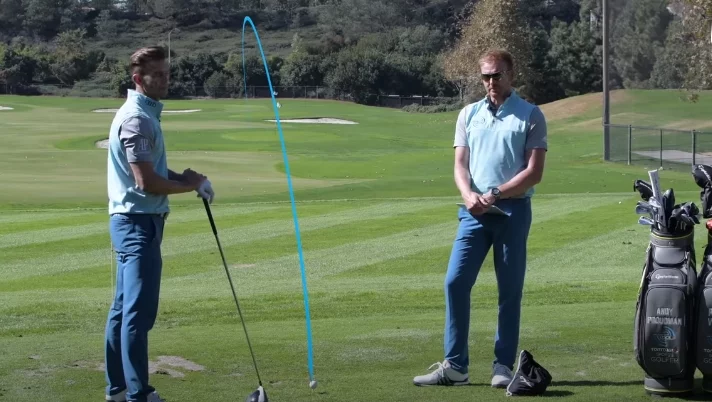
The over-the-top move is the single most common swing fault among amateur golfers. It happens when the right shoulder fires outward at the start of the downswing, throwing the club outside the target line before it drops into the hitting zone. The result is a steep, cutting path that produces the classic pull-slice combination. Understanding correct golf club swing mechanics — specifically, how to drop the club from the inside at transition — is the highest-leverage change most amateur golfers can make to their game.
Before you work on anything else, record your swing from behind and check your downswing path — most golfers are shocked by how steep they actually are at the start of the downswing.
When Straight Really Matters — And When It Doesn't
Here's something most instructors don't say directly: you don't need to hit the ball straight on every shot. Understanding when precision is non-negotiable — and when it isn't — helps you manage the course smarter and removes unnecessary pressure from your mechanics when it matters least.
Course Situations Where Straight Wins
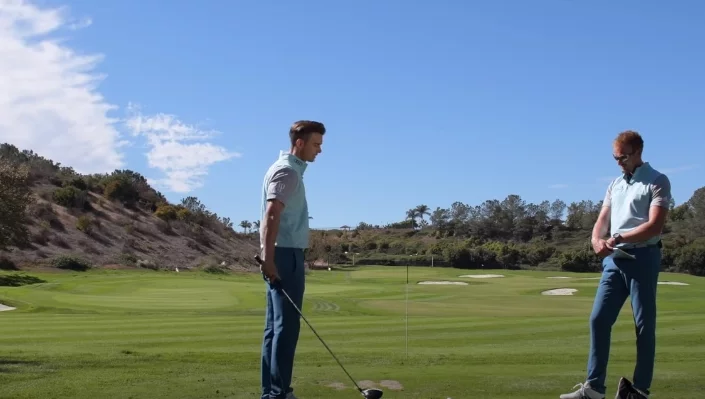
Off the tee on tight driving holes, straight is non-negotiable. When the fairway is narrow, the rough is penalizing, or water flanks the landing zone, accuracy matters more than distance. The same applies to approach shots into small greens with bunkers left and right — a controlled, straight ball is your most reliable weapon. Many golfers underestimate how significantly consistent direction improves scoring without any change in clubhead speed.
When a Controlled Curve Is the Better Play
On dogleg holes, a deliberate draw or fade gives you a shorter approach. Shaping a shot around trees, curving away from hazards, or working a ball into a back-left pin — these situations reward players who can control curve rather than just eliminate it. The goal isn't always a perfectly straight ball; the goal is to hit it where you intend. Once you can produce a straight shot reliably, learning controlled shot shaping becomes the real differentiator in course management at any level.
Beginner Fundamentals vs. Advanced Ball-Flight Control
The path to straighter shots looks completely different depending on where you are in your golf journey. Beginners and advanced players face different problems, and solving the wrong problem for your stage is one of the fastest ways to stall your development.
What Beginners Should Prioritize
If you're new to the game, the setup is everything. Your stance width, ball position, posture, and alignment account for the majority of ball-flight problems before you even begin your backswing. Work through our complete guide on correcting your golf posture and study your golf stance setup before obsessing over swing mechanics. Fixing your address position takes a single practice session; fixing a deeply grooved swing flaw can take months. Start where the leverage is highest.
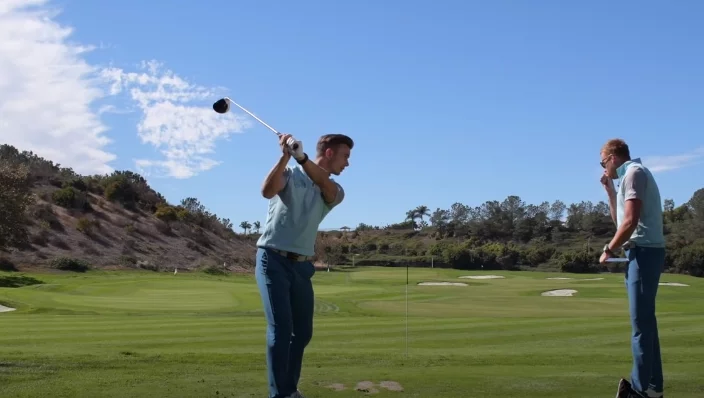
Beginners also tend to tighten up at address and throughout the swing. Tension is the enemy of clubface control. Practice swinging at 70% effort with a relaxed grip until the motion feels natural and repeatable — only then add speed incrementally.
What Advanced Players Focus On
At an intermediate and advanced level, the conversation shifts from mechanics to intent and feel. You've already got a functional swing — the question is whether you can control face angle under pressure and execute different shot shapes on demand. Advanced players use their swing follow-through position as a primary diagnostic tool: where the club finishes tells them almost everything about what happened at impact. A high, extended finish indicates good extension through the ball. A low, wrapping finish indicates the face closed early.
Pros don't hit it straight because they have perfect mechanics — they hit it straight because they've learned to deliver the face square consistently, even with an imperfect path.
Diagnosing Your Miss: A Troubleshooting Framework
Your miss pattern is data. Every shot that flies crooked tells you something specific about your impact geometry — if you know how to read it. Stop blaming course conditions or equipment and start treating every miss as a diagnostic message.
Fixing the Slice
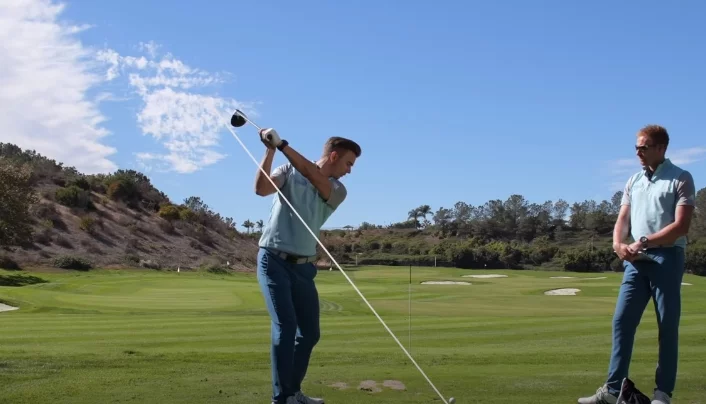
A slice — left-to-right curve for right-handed golfers — means your face is open relative to your swing path at impact. The fix starts with the face, not the path. Strengthen your grip slightly, feel the forearms rotate through impact, and focus on releasing the club toward the target rather than blocking through. Swinging more from the inside also helps by reducing the left-to-right glance across the ball. Fix the face first, then adjust the path — a strong inside path with an open face still produces a slice, just a gentler one.
Fixing the Hook
A hook means the face is closed relative to your path. This is often a grip issue — too strong a grip combined with aggressive forearm rotation through the hitting zone. Weaken the grip slightly and focus on keeping the face pointed at the sky through impact rather than rotating aggressively over. Hooks are generally easier to fix than slices because they indicate good speed and release through the ball. Redirect that energy with better face awareness and you'll produce powerful, controlled draws instead of destructive hooks.
How to Hit a Golf Ball Straight: Key Variables Compared
Understanding which variables affect your ball flight — and how much — lets you prioritize your practice time intelligently. Not every element carries equal weight, and spending sessions on low-leverage adjustments while ignoring high-leverage factors is what keeps most golfers stuck at the same performance level for years. The table below summarizes the core variables and their relative priority.
| Variable | Impact on Ball Flight | Fix Priority | Notes |
|---|---|---|---|
| Clubface Angle at Impact | 75–85% of starting direction | Highest | Grip orientation and forearm rotation are the primary controls |
| Swing Path | Determines the curve amount | High | Over-the-top path + open face = slice; inside path + closed face = hook |
| Grip Orientation | Directly governs face angle | High | Weak grip leaves face open; strong grip closes the face |
| Ball Position | Affects face angle at contact point | Medium | Too far back = face open; too far forward = face closing |
| Stance Alignment | Influences swing path direction | Medium | Open stance promotes out-to-in; closed promotes in-to-out |
| Posture at Address | Affects rotation quality | Medium | Poor posture restricts shoulder turn and arm extension |
| Grip Pressure | Affects wrist freedom through impact | Lower | Over-gripping restricts the natural face rotation back to square |
Use this table to audit your practice sessions honestly. If you're spending time on grip pressure adjustments but haven't addressed an over-the-top path, you're working the wrong end of the priority list. Fix the highest-impact variables first, and the lower-priority ones frequently self-correct without dedicated attention.
Frequently Asked Questions
Why do I hit my irons straight but slice my driver?
The driver's longer shaft and lower loft amplify every face angle error at impact. With irons, a slightly open face produces a manageable fade; with a driver, the same open face delivers a full slice. Focus on keeping the driver face square through a more deliberate, controlled release. Ball position also matters — the driver should be positioned inside your front heel to promote the correct upward strike angle through the impact zone.
How do I stop pulling the ball left consistently?
A pull indicates your clubface is closed and your path is out-to-in, launching the ball left of your target line. Check your alignment first — many pulls happen simply because your body is open to the target line at address. If alignment is correct, focus on releasing the club more toward the right (for right-handers) and working on dropping the club from the inside on the downswing rather than initiating with the right shoulder.
Does my shaft affect whether I hit it straight?
Yes, significantly. A shaft that's too stiff can leave the face open at impact if you don't generate enough swing speed to flex it correctly. A shaft that's too flexible delivers the face in an unpredictable position at the point of contact. If you're hitting consistent directional misses despite correct mechanics, it's worth reviewing our golf club shaft guide to confirm your equipment matches your actual swing speed.
How long does it take to hit straighter shots consistently?
With deliberate practice on the correct fundamentals — grip orientation, face angle awareness, and swing path — most golfers see meaningful improvement within four to six weeks. The critical distinction is deliberate practice versus casual ball-beating. Each session should carry a specific focus: a face-angle drill, then a path drill, then integrated full swings. Random practice without intent produces random, inconsistent results every time.
Should I aim for a perfectly straight ball or develop a consistent shot shape?
Most teaching professionals recommend developing a reliable, repeatable shot shape rather than chasing perfectly neutral flight. A consistent draw or fade is far more useful on an actual course than an inconsistent attempt at a straight ball that produces different misses every round. Once you identify your natural shape, you can align accordingly and improve your scoring immediately. A perfectly straight ball is an ideal — a reliable shape is a practical tool you can build a game around.
Straight shots aren't built in a single practice session — they're built through thousands of small, correct repetitions that eventually make square contact feel like the only natural thing you know how to do.



About Bill Winters
Those who have not yet tried the sport just can’t imagine what is driving these golfers to brave the sun’s heat and go around a course bigger than several football fields combined. It seems like an awful lot of work considering that the ball is quite small that is must be hard to hit, the ground of the course is not flat and, most annoying of all, there are sand traps lying around seemingly bent on preventing a player from finishing the course.
Follow & Subscribe for more:


About the Author

The game of golf may seem like an awful lot to take on when one considers that the ball is quite small, must be hard to hit and carry through windy conditions with little chance for error. The ground course has hillsides which make it challenging enough without adding sand traps who seem bent on preventing players from completing their round!
Get the FREE Gifts now. Or receive the latest golf eBooks for free from our bestselling.
Disable Ad Block to reveal all the secrets. Once done, hit a below button: