The TaylorMade SIM 2 MAX iron set is the top pick for intermediate golfers heading into 2026 — its multi-material Cap Back Design delivers a rare combination of distance, forgiveness, and forged-like feel that genuinely helps players break through scoring plateaus. Finding the right set of irons at the intermediate stage is one of the most impactful equipment decisions a golfer can make, and the choices available today are better than ever across every price point.
Intermediate golfers occupy a unique position on the learning curve. They've moved past the rank beginner phase, they understand ball flight, and they're starting to develop swing consistency — but they still need equipment that forgives off-center strikes while rewarding solid contact with real distance gains. The wrong iron set at this stage can actually slow progress, either by being too demanding for current swing mechanics or too forgiving to provide useful feedback. Understanding what separates a quality intermediate iron set from everything else is exactly what this guide covers. For a deeper look at how shaft characteristics affect performance, the guide on which flex is right for your golf clubs is worth reading alongside these reviews.
The seven iron sets reviewed below represent the best options available in 2026 across a range of budgets and playing styles. Each has been evaluated for forgiveness, distance consistency, feel on mishits, and overall value. These are some of the best irons in their respective categories, and every pick on this list earns a spot in our broader equipment reviews lineup. Whether the priority is maximum forgiveness, tour-level aesthetics, or sheer distance, there's a clear winner among these options.

Contents
Standout Models in 2026
- #PreviewProductRating
- Bestseller No. 1
 Rating:

- Bestseller No. 2
 Rating:
 - Bestseller No. 3
 Rating:
 - Bestseller No. 4
 Rating:
 - Bestseller No. 5
 Rating:
 - Bestseller No. 6
 Rating:
 - Bestseller No. 7
 Rating:
In-Depth Reviews
1. TaylorMade Golf SIM 2 MAX Iron Set — Best Overall for Intermediate Golfers
TaylorMade's SIM 2 MAX irons have held up exceptionally well since their release, and in 2026 they remain one of the most complete iron sets available for players trying to sharpen their game. The headline technology is the all-new multi-material Cap Back Design, which combines high-strength stainless steel with ultralight polymer inserts to shift the center of gravity as low as possible without compromising structural integrity. Lower CG translates directly into higher launch angles on iron shots — a significant benefit for intermediate golfers who struggle to get long irons airborne consistently.
The face technology is equally impressive. The SIM 2 MAX uses a fast, forgiving face geometry that expands the sweet spot noticeably compared to more compact players irons. On off-center strikes — a reality for any golfer still refining swing mechanics — distance loss is minimized and directional error stays manageable. The ECHO Damping System is what separates this set from other distance-focused irons: a soft polymer blend inside the head absorbs the harsh vibrations typical of hollow-body construction, producing feedback that feels closer to a solid forged iron than to the metallic clang common in game-improvement sets. That combination of distance, forgiveness, and feel is genuinely rare in a single package.
This set runs 5-PW plus AW with steel stiff shafts, making it a solid fit for players whose swing speeds have developed to the point where regular flex feels loose but extra stiff is too demanding. The overall package — technology, playability, and feel — earns the SIM 2 MAX its position at the top of this list.
Pros:
- Cap Back Design achieves an exceptionally low CG for high, penetrating ball flight
- ECHO Damping System produces forged-iron-like feel despite hollow construction
- Wide forgiveness window reduces distance loss on mishits significantly
- Steel stiff shafts suit a broad range of developing swing speeds
Cons:
- Aggressive offset and sole width may feel bulky to golfers transitioning toward players irons
- Available at a premium price compared to some competitors at this performance level
2. Callaway Golf 2024 Rogue ST Max Iron Set — Best for Maximum Distance
The 2024 Callaway Rogue ST Max is the most current generation iron on this list, and it arrives with Callaway's most refined version of the Rogue platform to date. The "ST Max" designation signals exactly what it delivers: maximum stability and distance from a head shape optimized for players who want every yard the club can offer without sacrificing playability. Callaway's A.I. face architecture, refined across multiple generations, ensures that the face flexes optimally across its entire surface area — not just at the center — so even toe and heel strikes maintain respectable ball speed.
The 2024 update brings refinements to the internal weighting structure compared to earlier Rogue ST iterations. Tungsten energy cores position mass precisely within each individual iron head, meaning the 5-iron and the PW are engineered with completely different internal geometries — not simply scaled versions of the same design. This results in consistent gapping between clubs, which is something intermediate golfers genuinely benefit from as they start to manage courses more intentionally. The steel stiff shaft combination across the 5-iron through PW and AW set keeps the setup accessible while delivering enough control for players with improving ball-striking consistency.
The Rogue ST Max configuration runs compact enough to look respectable at address without the intimidating blade-like profile of a true players iron. It sits confidently behind the ball, inspires confidence, and backs that confidence up with genuine ball speed numbers. For intermediate golfers who prioritize distance as their primary upgrade driver in 2026, this set is the definitive choice.
Pros:
- A.I.-optimized face delivers high ball speed across the entire face, not just center strikes
- Per-iron tungsten weighting creates precise, consistent gapping throughout the set
- 2024 update represents the most refined Rogue platform yet
- Confidence-inspiring head shape suits the transition from super game-improvement irons
Cons:
- As a 2024 model, price reflects current-generation premium positioning
- Feature descriptions from Amazon listing are minimal — buyers should research shaft specs independently before purchasing
3. PING G430 Iron Set — Best for Consistent Feel and Accuracy
PING's G430 iron set represents the best of what one of golf's most engineering-focused manufacturers produces for the game-improvement and mid-handicapper market. PING has a long history of building irons that reward accurate swings while still protecting players from the worst consequences of mishits, and the G430 continues that tradition with an updated internal design and PING's proprietary AWT 2.0 (Ascending Weight Technology) steel shaft. The AWT 2.0 shaft is purpose-built for iron sets — lighter in the long irons to promote higher launch and heavier in the short irons to enhance control — which makes this a genuinely integrated system rather than a generic shaft installation.
The G430 head design uses a hydropearl chrome finish that resists moisture in wet turf conditions — a practical engineering detail that most competitors overlook. The face is precision-engineered with PING's Spinsistency technology, which reduces spin variation on off-center strikes. For intermediate golfers who are starting to work the ball and need more predictable trajectories, this matters enormously. When the spin rate fluctuates dramatically from one strike to the next, distance control becomes nearly impossible. The G430 addresses this directly. This listing includes the shop-worn designation from PING directly, which typically means minimal cosmetic wear at a reduced entry point.
The Black Dot configuration indicates this set is built standard with slightly weaker lofts than the colored dot equivalents, favoring higher trajectory and softer landing angles. For most intermediate golfers playing typical parkland and resort courses, that's the ideal specification. The 5-PW configuration with the AWT 2.0 stiff shaft is a near-perfect intermediate package from one of the most trusted brands in the business.
Pros:
- AWT 2.0 shaft technology is specifically engineered to complement iron set performance
- Spinsistency technology reduces spin variation for more predictable distance control
- Hydropearl finish maintains performance in wet conditions
- Shop-worn designation from PING offers reduced pricing with manufacturer backing
Cons:
- Shop-worn status may mean limited availability or incomplete set configurations
- Black Dot spec produces higher, softer trajectories — not ideal for golfers who already hit it too high
4. Cleveland Launcher XL Halo Iron Set — Best Forgiveness-First Option
Cleveland Golf built the Launcher XL Halo around a single guiding principle: maximum forgiveness without compromise. The XL head design is not subtle — this is one of the largest iron head profiles on this list, intentionally so. The 7-iron achieves a moment of inertia (MOI) of 2,908 g-cm² — the highest Cleveland has ever engineered into a game-improvement hybrid iron — which translates directly into dramatic resistance to twisting on off-center strikes. For intermediate golfers who still battle with heel and toe misses, that MOI figure is not just a marketing number. It produces a measurable reduction in directional error that shows up in scoring.
The sole design on the Launcher XL Halo is cleverly engineered to transition through the set. Long irons use a Gliderail in the sole — a raised central ridge that helps the club slide through turf rather than digging — while short irons and wedges transition to a V-shaped sole and ultimately a three-tiered sole on the dual and sand wedges. This means the turf interaction characteristics change appropriately as the set progresses, rather than applying one universal sole shape to every head. The MainFrame variable face technology, developed using artificial intelligence, further increases ball speed and distributes forgiveness across the face more efficiently than conventional variable thickness designs. This set runs 5-iron through dual wedge and sand wedge (DW), giving players a complete scoring package without needing to source additional short irons separately.
Players prioritizing forgiveness above all else — including those dealing with swing inconsistencies or recovering from layoffs — should look at the Launcher XL Halo first. Cleveland's reputation in the wedge category also ensures the short irons and scoring clubs in this set are particularly well-executed. Speaking of wedges, understanding the full wedge ecosystem is valuable for any golfer building out their bag — the Golf Wedge Buyer's Guide provides a thorough breakdown of what to look for beyond the iron set itself.
Pros:
- 2,908 g-cm² MOI in the 7-iron delivers record-level forgiveness for the intermediate market
- Graduated sole design (Gliderail to V-sole to tiered sole) optimizes turf interaction across the set
- Includes dual wedge and sand wedge — a complete package without separate wedge purchases
- AI-designed MainFrame face boosts ball speed on every part of the face
Cons:
- XL head profile is large — players who prefer a more compact iron appearance may find the look at address challenging
- Less suited to players whose games have advanced to the point where shot shaping matters
5. Mizuno JPX925 Hot Metal Irons — Best Feel with Distance
Mizuno has an almost mythological reputation for iron feel among serious golfers, and the JPX925 Hot Metal set demonstrates exactly why that reputation endures. The Hot Metal line is Mizuno's distance-focused offering within the JPX family, but unlike some manufacturers who sacrifice feel entirely in pursuit of ball speed, Mizuno's CORTECH face design maintains tactile feedback even as it pushes coefficient of restitution toward its legal limit. CORTECH optimizes face thickness distribution across the entire hitting area, expanding the high-COR zone far beyond what a conventional machined face produces.
The Seamless Cup Face construction is the engineering centerpiece of the JPX925 HM. Rather than welding a separate face insert to the body, Mizuno thins the face material revolving 360 degrees around the perimeter — a continuous, seamless structure that increases the rebound area uniformly. This means ball speed doesn't drop dramatically when contact drifts toward the edges. Variable Sole Thickness further increases overall face flex, adding another layer of ball speed support across the lower face where many intermediate golfers make contact on longer irons. The result is a set that competes with the most aggressively engineered distance irons on the market while still delivering the nuanced feedback Mizuno's manufacturing process is known for.
This particular listing covers a 7-piece set running 5-iron through gap wedge (GW) with a steel regular shaft — an important note for buyers whose swing speeds sit more comfortably in the regular flex range. Mizuno's Japanese manufacturing and meticulous quality control also mean set-to-set consistency is extremely high, a detail that matters for intermediate players starting to track their performance numbers more seriously. For players building their full bag alongside this iron set, the approach to hitting a hybrid golf club is a useful companion read since most intermediate players pair iron sets with at least one hybrid in the long game.
Pros:
- Seamless Cup Face expands the high-COR zone for consistent ball speed across the entire face
- CORTECH and Variable Sole Thickness deliver exceptional distance for a Mizuno game-improvement iron
- Tactile feel on center strikes is notably better than most hollow-body distance irons
- 7-piece set including GW provides complete coverage through the scoring range
Cons:
- Regular flex shaft limits this listing to players with moderate swing speeds — faster swingers need to seek stiff shaft configurations
- Mizuno's premium positioning means this set sits at the higher end of the price spectrum
6. TaylorMade Golf Stealth HD Iron Set — Best for Easy Launch
The TaylorMade Stealth HD irons share DNA with the top-ranked SIM 2 MAX on this list, but the Stealth HD takes the forgiveness and launch-assistance formula a step further for golfers who specifically need help getting the ball airborne. The low-profile head with a shallow face height and wide sole is engineered from the ground up to push the center of gravity as close to the ground as physically possible. Increased sole curvature on top of that assists with turf interaction, meaning golfers with steeper attack angles or those who tend to catch the turf early don't experience the dramatic energy loss that typically comes with that pattern.
The multi-material Cap Back Design — the same fundamental platform as the SIM 2 MAX — combines high-strength stainless steel with ultralight polymers. The key difference in the Stealth HD application is the emphasis on the "HD" (High Draw) bias, which produces a slight right-to-left curvature for right-handed golfers. This is particularly valuable for intermediate players who battle a persistent slice, as the built-in draw bias counteracts the left-to-right spin axis without requiring swing changes. The ECHO Damping System appears here as well, using soft polymer and multiple contact points across the face to absorb the metallic harshness inherent in hollow-body iron construction. Feel at impact, particularly on well-struck shots, is genuinely pleasant.
This set runs 5-iron through PW and AW in steel stiff — the same configuration as the SIM 2 MAX. The Stealth HD earns its spot on this list specifically for intermediate golfers who have identified launch and draw bias as their primary performance needs. It's a more targeted tool than the SIM 2 MAX, and for the right player profile, it performs exceptionally well.
Pros:
- Built-in high-draw bias helps intermediate golfers combat slice tendencies without swing adjustments
- Extra-low CG from shallow face and wide sole produces the highest launch angle on this list
- ECHO Damping System delivers surprisingly pleasant feel for a draw-bias game-improvement iron
- Increased sole curvature improves turf interaction for golfers with steeper angles of attack
Cons:
- Draw bias is a liability for golfers who already play a draw or hook — this set is specifically for fade/slice tendencies
- Very wide sole and low profile may appear bulky compared to mid-sized game-improvement designs
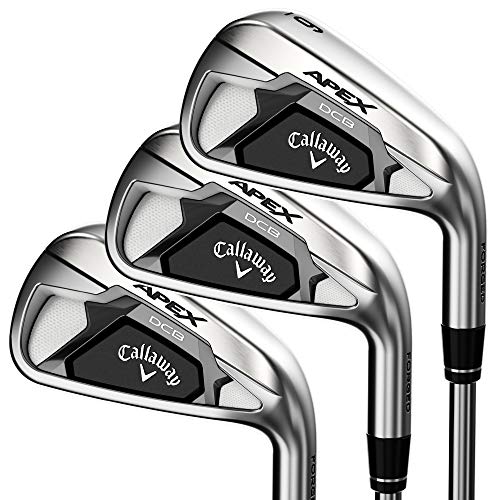
7. Callaway Apex DCB Iron Set — Best Players-Inspired Forgiveness
The Callaway Apex DCB occupies a unique position in the iron market — and on this list. "DCB" stands for Deep Cavity Back, and it describes an iron that delivers the aesthetic and feel of a forged players club alongside the structural forgiveness of a deep cavity back. For intermediate golfers who are progressing quickly and feel they're nearing the territory where super game-improvement irons start to feel too clunky, the Apex DCB offers a graceful step toward a more refined iron without abandoning the forgiveness safety net that still serves a useful role in their game.
Callaway's forging process for the Apex line produces a grain structure in the steel that transmits vibration differently than cast iron — a difference that skilled golfers describe as "softer" or "more connected" feedback at impact. The DCB cavity design maintains high MOI values while creating the cleaner top-line appearance that more accomplished players prefer. This is not a blade. It's not a true players iron. But it looks and feels considerably closer to one than any other iron on this list, and that matters for golfers whose skill level is advancing toward the point where equipment aesthetics start to influence confidence.
This listing covers a 4-PW configuration with steel regular shafts — a longer set than the 5-PW standard, meaning buyers get a 4-iron included. The regular flex designation suits players with more moderate swing speeds. The Apex DCB is the right choice for intermediate golfers who have genuinely outgrown game-improvement irons and want a set that will grow with them into the single-digit handicap range. According to Wikipedia's overview of golf irons, cavity back designs fundamentally redistributed mass around the perimeter — Callaway's Apex DCB represents the current pinnacle of that design philosophy in a forged package.
Pros:
- Forged construction delivers superior feel and feedback compared to cast game-improvement alternatives
- Deep cavity back provides genuine forgiveness without the oversized head profile of typical GI irons
- 4-iron through PW configuration gives players more long-iron coverage
- Ideal for advancing intermediate golfers who want a set to grow into single-digit handicaps
Cons:
- Regular flex steel shafts may not suit faster-swinging intermediate players
- 2021 model year means newer technologies have emerged — buyers who want cutting-edge face engineering should consider more recent options
Key Features to Consider When Choosing Men's Golf Irons
Forgiveness vs. Workability: Finding the Right Balance
The most important decision intermediate golfers face when choosing iron sets is how to balance forgiveness against shot-making capability. Game-improvement irons prioritize forgiveness through large heads, wide soles, perimeter weighting, and cavity back designs — they protect against mishits but limit the ability to intentionally shape shots. Players irons offer precise feedback and workability but punish inconsistent contact severely. The intermediate golfer's sweet spot sits in the game-improvement to mid-player crossover category, where designs like the Apex DCB and PING G430 live. As swing consistency improves, players can migrate toward less forgiving designs — but starting with too little forgiveness slows progress and leads to frustration.
Shaft Flex and Material: Getting This Right Matters More Than Most Buyers Realize
Every iron set on this list ships in steel — the right call for most adult intermediate male golfers. Steel shafts provide more consistent bend profiles, better directional control, and more precise feedback than graphite at comparable swing speeds. But flex matters enormously within the steel shaft category. Stiff flex suits players with iron swing speeds roughly in the 85-95 mph range (measured at the 6-iron), while regular flex suits the 75-85 mph range. An incorrect flex produces offline shots even with perfect swing mechanics — too stiff causes blocked pushes and low ball flights, while too soft produces high draws or hooks with inconsistent distances. Before purchasing any iron set, knowing current 6-iron swing speed is essential. The comprehensive breakdown of shaft characteristics in the club flex guide explains this in greater detail for golfers who want to dial in the right specification.
Set Configuration: Which Clubs Are Actually in the Box
Iron set configurations vary significantly across the options on this list. A standard 5-PW set includes six clubs. Sets that also include AW (approach wedge or gap wedge) provide seven clubs and fill a critical distance gap between the pitching wedge and sand wedge. The Cleveland Launcher XL Halo goes further, including a dual wedge and sand wedge for a complete 5-DW package. Intermediate golfers benefit from gap wedge inclusion — the distance window between a typical PW (40-45 yards loft) and a sand wedge (54-56 degrees) is too large to navigate without a dedicated club at most courses. Before purchasing a set, map out the existing bag and confirm which clubs the new set replaces and which remain as separate purchases.
Head Size, Offset, and Address Aesthetics
How an iron looks at address affects confidence, which affects swing quality. Game-improvement irons typically feature wider soles, more visible offset (the distance the leading edge sits behind the hosel), and thicker top lines — all of which aid launch and forgiveness but can look imposing to golfers who've developed strong visualization habits. Players who find large iron heads visually distracting at address tend to perform better with mid-sized designs like the PING G430 or Apex DCB. Players who don't notice or don't care about head aesthetics extract more benefit from the forgiveness that larger heads provide. When possible, seeing the irons in person or at a demo day before purchasing is the most reliable way to assess address appearance — specs on a page don't fully capture how different head shapes affect confidence in real playing conditions.
Frequently Asked Questions
What irons are best for intermediate golfers in 2026?
The TaylorMade SIM 2 MAX ranks as the best overall iron set for intermediate golfers in 2026, offering a rare combination of distance, forgiveness, and forged-like feel through its Cap Back Design and ECHO Damping System. The Callaway Rogue ST Max and PING G430 are strong alternatives depending on whether distance or feel consistency is the priority. The right choice ultimately depends on swing speed, current ball flight tendencies, and how quickly the player expects to advance beyond game-improvement territory.
How do intermediate golfers differ from beginners when it comes to iron selection?
Beginners benefit most from maximum forgiveness and the lightest possible feedback penalty for poor contact — super game-improvement irons with large offsets and extremely high MOI values suit this stage. Intermediate golfers have developed enough swing consistency to begin extracting performance from more refined designs. They need irons that still protect against mishits but start providing more useful feedback on well-struck shots. The crossover from game-improvement to mid-player iron territory is the defining equipment transition for this stage of development.
Should intermediate golfers use steel or graphite shafts in their irons?
Steel shafts are the standard recommendation for intermediate male golfers with developing but functional swing mechanics. Steel provides more consistent flex profiles, better directional feedback, and more precise distance control than graphite at equivalent swing speeds. Graphite iron shafts make sense for golfers dealing with joint issues, those with swing speeds below approximately 75 mph at the 6-iron, or senior players whose swing speeds have declined significantly. For most intermediate male golfers in good physical health, steel in stiff or regular flex is the correct choice.
What is the difference between stiff and regular flex for intermediate golfers?
Stiff flex iron shafts are designed for swing speeds roughly between 85 and 95 mph at the 6-iron, while regular flex suits the 75 to 85 mph range. Choosing the wrong flex produces offline shots and inconsistent distances regardless of swing quality. Intermediate golfers who are unsure of their swing speed should seek a launch monitor session at a local pro shop or golf retailer before committing to a shaft flex. Getting this decision right is arguably more important than the specific iron head model chosen — shaft flex mismatches are one of the most common and correctable equipment errors among intermediate players.
How many irons should an intermediate golfer carry?
Under standard Rules of Golf, a player may carry up to 14 clubs total. Most intermediate golfers carry a driver, 3-wood or 5-wood, one or two hybrids, a 5-iron through pitching wedge iron set, one or two additional wedges, and a putter — typically 12 to 14 clubs. The hybrid-to-iron transition point is a matter of personal preference and skill level; many intermediate golfers replace their 3 and 4 irons with hybrids since those long irons are exceptionally difficult to hit consistently. A 5-iron through gap or pitching wedge set provides the core scoring range most intermediate rounds require.
Are older iron set models worth buying in 2026?
Yes — older model iron sets frequently represent excellent value in 2026, particularly when the technology gap between model years is modest. The TaylorMade SIM 2 MAX from 2021 and the Callaway Apex DCB also from 2021 both remain highly competitive options despite being several years old. Iron technology advances more incrementally than driver technology, meaning a well-designed set from three to four years ago still performs within a few percentage points of current models. Golfers on a budget can find previous-generation sets at significantly reduced prices without meaningful performance sacrifice. The most important factors — forgiveness, shaft flex match, and head aesthetics — don't expire.
Buy on Walmart
- TaylorMade Golf SIM 2 MAX IRON SET MENS RIGHT HAND STEEL STI — Walmart Link
- Callaway Golf 2024 Rogue ST Max Iron Set (Right, Steel, Stif — Walmart Link
- PING G430 IRON SET 5-PW, 45 BLACK DOT AWT 2.0 Stiff Right Ha — Walmart Link
- Cleveland Launcher XL Halo Iron Set RH 5-DW Steel Stiff — Walmart Link
- Mizuno JPX925 Hot Metal Irons | 7 pc 5-GW Iron Set | RH/Stee — Walmart Link
- TaylorMade Golf Stealth HD Steel Iron Set 5 - PW/AW Right Ha — Walmart Link
- Callaway 2021 Apex DCB Iron Sets, 4-PW, Steel, Regular, Stan — Walmart Link
Buy on eBay
- TaylorMade Golf SIM 2 MAX IRON SET MENS RIGHT HAND STEEL STI — eBay Link
- Callaway Golf 2024 Rogue ST Max Iron Set (Right, Steel, Stif — eBay Link
- PING G430 IRON SET 5-PW, 45 BLACK DOT AWT 2.0 Stiff Right Ha — eBay Link
- Cleveland Launcher XL Halo Iron Set RH 5-DW Steel Stiff — eBay Link
- Mizuno JPX925 Hot Metal Irons | 7 pc 5-GW Iron Set | RH/Stee — eBay Link
- TaylorMade Golf Stealth HD Steel Iron Set 5 - PW/AW Right Ha — eBay Link
- Callaway 2021 Apex DCB Iron Sets, 4-PW, Steel, Regular, Stan — eBay Link
Final Thoughts
Finding the right iron set is one of the highest-impact equipment decisions an intermediate golfer can make in 2026 — and every option on this list earns a genuine recommendation for the right buyer profile. The TaylorMade SIM 2 MAX remains the top overall pick for its unmatched combination of distance, forgiveness, and feel, but the Callaway Rogue ST Max, PING G430, and Mizuno JPX925 each present compelling cases for players whose priorities align with their respective strengths. Browse the full product listings, match the shaft flex to current swing speed, and make a selection — the game rewards players who put the right tools in the bag.



About Bill Winters
Those who have not yet tried the sport just can’t imagine what is driving these golfers to brave the sun’s heat and go around a course bigger than several football fields combined. It seems like an awful lot of work considering that the ball is quite small that is must be hard to hit, the ground of the course is not flat and, most annoying of all, there are sand traps lying around seemingly bent on preventing a player from finishing the course.
Follow & Subscribe for more:


About the Author

The game of golf may seem like an awful lot to take on when one considers that the ball is quite small, must be hard to hit and carry through windy conditions with little chance for error. The ground course has hillsides which make it challenging enough without adding sand traps who seem bent on preventing players from completing their round!
Get the FREE Gifts now. Or receive the latest golf eBooks for free from our bestselling.
Disable Ad Block to reveal all the secrets. Once done, hit a below button: