Learning how to play golf for beginners comes down to three fundamentals: grip, stance, and swing. Get those right, and everything else clicks into place. This beginner's guide to golf walks you through every essential skill — from your first range session to reading the green — so you can step onto the course with real confidence.

Most new golfers overthink the game. They buy too much equipment, watch hundreds of videos, and end up paralyzed before they ever hit a ball. The truth is, you can learn the basics in a single afternoon. What separates confident beginners from frustrated ones is focusing on the right fundamentals from day one.
The game itself is simple: golf is played over 18 holes — or 9 if you're just starting out. Your goal is to get the ball into each hole in as few strokes as possible. Every hole has a "par" rating, the number of strokes an expert is expected to use. As a beginner, finishing a round and having fun is the only target that matters.
Contents
How to Play Golf for Beginners: Your First Steps
The fastest path to enjoying golf is structured practice before you ever book a tee time. Here's how to use your first few sessions wisely.
Start on the Driving Range, Not the Course
The driving range is where your game is built. Before you pay for a full round, spend two or three sessions at a range. Here's why it works:
- You hit unlimited balls without slowing down other players
- You focus on one skill at a time, with no pressure
- You get immediate feedback on every swing
- Mistakes cost nothing — no penalty strokes, no embarrassment
Start with a 7-iron every time. It sits right in the middle of your bag, offers enough loft to get the ball airborne easily, and forgives off-center hits better than longer clubs. Once you're making decent contact consistently, move to shorter irons, then a driver.
Before you book your first tee time, check how much time to budget by reading our guide on how long 9 holes of golf take — you'll want to plan ahead, especially on busy weekends.
Master Three Clubs Before Everything Else
You don't need to feel comfortable with every club on day one. Pick three and commit to them:
- 7-iron — your all-purpose learning club for full swings
- Putter — you'll use this on every single hole
- Driver or 3-wood — for tee shots on longer holes
Consistency with three clubs beats mediocrity with fourteen. Rotate between these during every practice session. Add more clubs to your rotation only when these three feel natural.
Build a Pre-Shot Routine
Every solid golfer uses a repeatable setup process before each swing. Your routine should include:
- Stand behind the ball and pick a specific target
- Walk up and position your feet shoulder-width apart
- Check your grip and align your clubface to the target
- Take one slow breath, then commit to the swing
Your grip and stance are the two biggest factors before the ball is ever struck. Learn the correct way to hold the club from our guide on proper golf club grip technique, then lock in a solid setup with our tips on how to perfect your golf stance.
The Right Golf Equipment: What You Actually Need
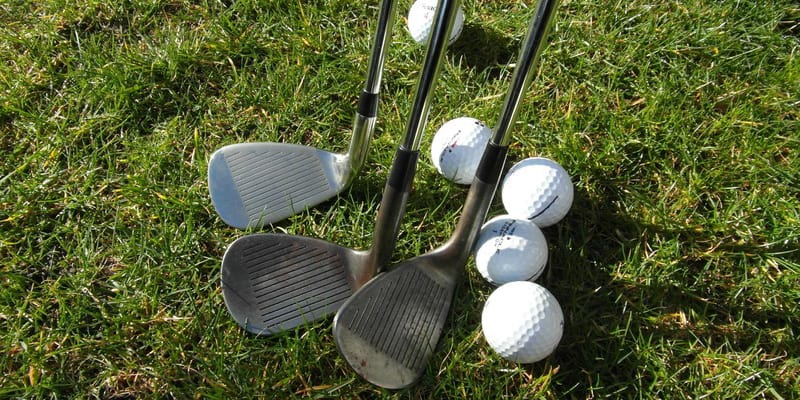
You don't need a premium set to learn golf. But the right gear for your skill level makes a real difference in how fast you improve.
Essential Clubs for Beginners
A solid beginner set includes:
- Driver — for long tee shots
- Fairway wood or hybrid — long shots from the fairway or rough
- Mid-irons (6, 7, 8, 9) — approach shots to the green
- Pitching wedge — short approaches and chip shots
- Putter — every hole, every round
The rules allow up to 14 clubs, but 8–10 is plenty when you're starting out. Look for a forgiving beginner golf club set built with larger clubfaces and low centers of gravity — these help you get the ball airborne even on off-center strikes, which is exactly what beginners need.
Balls, Tees, and Other Must-Haves
Beyond clubs, you need a handful of basics:
- Golf balls — buy a value pack to start; check out the best golf balls reviewed when you're ready to upgrade
- Tees — a small bag of wooden or plastic tees lasts for months
- Golf glove — improves grip and prevents blisters on your lead hand
- Comfortable shoes — golf spikes help but aren't required at most public courses
What You Can Skip at First
Save your money on these until you've played a dozen rounds:
- Premium tour-level golf balls
- A full 14-club bag with specialty wedges
- A GPS watch or rangefinder
- Expensive custom-fitted irons

| Club Type | Best Used For | Difficulty to Hit | Beginner Priority |
|---|---|---|---|
| Driver | Long tee shots (200+ yards) | Hard | Medium |
| Fairway Wood | Long shots from the fairway | Medium-Hard | Low |
| Hybrid | Replacing long irons, rough shots | Easy | High |
| Mid-Iron (6–7) | Approach shots, 150–180 yards | Medium | High |
| Short Iron (8–9) | Short approaches, 100–150 yards | Easy | High |
| Pitching Wedge | Chips and short approaches, 80–110 yards | Easy | Essential |
| Putter | On the green, every hole | Variable | Essential |
Golf Myths That Hold Beginners Back
Misinformation stops more people from picking up a club than bad swings ever will. Let's clear up the biggest ones.

Myth: Golf Is Too Expensive to Start
Golf can be expensive — but it absolutely doesn't have to be. Here's the actual cost breakdown to get started:
- Used beginner club sets: $100–$250
- Public course green fees: $20–$50 per round
- Driving range buckets: $10–$20 per session
- A sleeve of golf balls: $5–$15
Plenty of great golfers started on a $150 used set from a sporting goods store. You don't need a country club membership or brand-new irons. Buy used, play public courses, and upgrade your gear only once you know you love the game.
Myth: You Need to Be Athletic to Play Golf
Golf rewards technique, not raw strength. A smooth, repeatable swing beats muscle every time. Players of all ages, sizes, and fitness levels compete and enjoy the game regularly. The flexibility and core stability you need develop naturally through playing — no gym membership required before you start.
Myth: You Must Know Every Rule Before Playing
According to the Rules of Golf, there are dozens of detailed regulations. But as a beginner, you only need to know these five:
- Play the ball where it lies — don't move it unless a rule allows it
- Count every stroke, including penalty strokes
- Don't touch your ball on the green until it's your turn to putt
- Replace any divots you take from the fairway
- Rake the bunker (sand trap) smooth after you leave it
That's enough to get through a round without holding anyone up or embarrassing yourself. Learn the full rulebook gradually as you play more rounds.
Golf Club Types Compared: Finding the Right Stick
Not every club does the same job. Understanding what each category is built for helps you pick the right tool for every situation on the course.
Woods, Irons, and Wedges at a Glance
Woods (Driver, 3-wood, 5-wood)
- Built for maximum distance off the tee and fairway
- Large clubhead for a bigger sweet spot
- The driver is the longest club in the bag — and the hardest to control
Irons (3–9 iron)
- Mid-range versatility for approach shots
- Smaller clubhead gives you more control and shot-shaping ability
- Lower number = less loft = more distance; higher number = more loft = shorter, higher ball flight
Wedges (Pitching, Gap, Sand, Lob)
- High-loft clubs designed for short, precise shots around the green
- Your pitching wedge covers 80–110 yards; a sand wedge gets you out of bunkers
- These clubs account for a huge percentage of your scoring shots
Why Beginners Should Consider Hybrids
If you're struggling to hit long irons (3, 4, 5), replace them with hybrids. A hybrid combines the easy launch of a fairway wood with the control of an iron. Most beginners hit hybrids 20–30% more consistently than traditional long irons — and the forgiveness on off-center hits is dramatically better. It's the single smartest equipment swap a new golfer can make.

Fixing the Most Common Beginner Golf Mistakes
Every beginner makes the same mistakes. The good news: each one has a clear, straightforward fix you can apply right away.
The Slice (Ball Curves Hard to the Right)
A slice happens when your clubface is open at impact, sending the ball curving sharply to the right for right-handed players. It's the most common beginner miss. Fix it by doing these three things:
- Strengthen your grip — rotate both hands slightly to the right on the handle so you can see two or three knuckles on your left hand at address
- Align your feet parallel to your target line — don't aim left to compensate for the curve; that makes the slice worse
- Rotate your forearms through impact — think of turning your right palm toward the ground as you swing through the ball
Topping the Ball (It Rolls Instead of Flying)
Topping means you're catching the top of the ball instead of the center, and it almost always comes from lifting your head during the swing. Fix it with these habits:
- Keep your eyes locked on the back of the ball through impact — don't look up early
- Maintain solid golf posture from setup through the finish — don't straighten your knees mid-swing
- Trust the club's loft to get the ball in the air — never try to scoop or lift it yourself
Putting Problems (Too Many Strokes on the Green)
Putting accounts for roughly 40% of your total strokes in a round. If you're three-putting every hole, your scores will never come down regardless of how well you drive the ball. Focus on:
- Distance control first — most beginners miss putts long or short, not left or right
- Reading the slope of the green before you stand over the ball
- Using a smooth pendulum stroke — no wrist flip at impact
- Practicing 3-foot and 6-foot putts until they feel automatic
For your full swing mechanics, our detailed breakdown of how to achieve the correct golf club swing covers every phase from takeaway to follow-through in plain language.

Frequently Asked Questions
How long does it take to learn how to play golf for beginners?
Most beginners can play a full 9-hole round with reasonable confidence after 2–4 months of regular practice. You'll start making decent contact much sooner — often within your first few driving range sessions. Consistency comes with repetition, so practice two or three times per week if you want to improve quickly.
How many clubs does a beginner actually need?
You're allowed up to 14 clubs in your bag, but 8–10 is more than enough when you're starting out. A driver, a fairway wood or hybrid, mid-irons (6 through 9), a pitching wedge, and a putter cover every situation you'll face on a standard course. Keep it simple until you understand what each club does naturally.
What does "par" mean in golf?
Par is the number of strokes a skilled golfer is expected to need to complete a hole. Most holes are par 3, 4, or 5. A standard 18-hole course typically plays to a total par of 72. As a beginner, don't stress about par — focus on completing each hole and having fun rather than chasing a number.
Can you teach yourself golf without taking lessons?
Yes, but a few lessons from a certified PGA professional early on saves you months of frustration. Even two or three sessions to correct your grip and swing basics makes a measurable difference in how fast you improve. Think of it as an investment — fixing bad habits early is far easier than unlearning them later.
What is a golf handicap and do beginners need one?
A handicap is a number that measures your playing ability — lower numbers mean better players. It's calculated based on your recent scores relative to the difficulty of the courses you play. As a brand-new golfer, you don't need one right away. Once you start playing regular rounds and submitting scorecards through a golf association, your handicap establishes itself automatically.
What is the best first club for a beginner to practice with?
Start every practice session with a 7-iron. It has enough loft to launch the ball easily, enough shaft length to generate real distance, and it's among the most forgiving clubs in any set. Once you're making consistent contact with a 7-iron, expand to shorter and longer clubs gradually. Rushing to the driver too soon is one of the most common beginner mistakes.
What is proper golf etiquette for beginners on the course?
Golf etiquette is just as important as the rules. Always stand still and stay quiet when another player is hitting. Let faster groups play through if you're moving slowly. Keep your phone on silent, don't drag your feet across another player's putting line, and keep pace with the group ahead of you. Respecting other golfers on the course makes the game better for everyone.
Final Thoughts
You now have everything you need to get off the couch and onto the course. Grab a forgiving beginner club set, book an hour at your nearest driving range, and start with the fundamentals covered in this guide — grip, stance, and a consistent pre-shot routine. Golf rewards the players who practice smart, stay patient, and actually show up. Your first round is closer than you think.



About Bill Winters
Those who have not yet tried the sport just can’t imagine what is driving these golfers to brave the sun’s heat and go around a course bigger than several football fields combined. It seems like an awful lot of work considering that the ball is quite small that is must be hard to hit, the ground of the course is not flat and, most annoying of all, there are sand traps lying around seemingly bent on preventing a player from finishing the course.
Follow & Subscribe for more:


About the Author

The game of golf may seem like an awful lot to take on when one considers that the ball is quite small, must be hard to hit and carry through windy conditions with little chance for error. The ground course has hillsides which make it challenging enough without adding sand traps who seem bent on preventing players from completing their round!
Get the FREE Gifts now. Or receive the latest golf eBooks for free from our bestselling.
Disable Ad Block to reveal all the secrets. Once done, hit a below button: