Which golf rangefinder actually delivers accurate readings when it matters most — standing 178 yards from the pin on a breezy afternoon, with trees and a false front complicating every calculation? Our team tested seven of the leading models across multiple courses and weather conditions in 2026, and our top pick is the Bushnell Pro XE. It is the most complete rangefinder on the market, combining slope-with-elements compensation, rapid pin acquisition, and a magnetic cart mount that makes it genuinely effortless to use round after round.
Laser rangefinders calculate distance by timing how long a pulse of light takes to reach a target and bounce back — a process that, in premium golf-specific units, now achieves accuracy within an inch of the flagstick at ranges beyond 400 yards. The technology has matured significantly, and the 2026 lineup includes devices that pair raw laser speed with GPS course overlays, vibration feedback, weather compensation, and auto-adjusting displays. For any golfer serious about improving their game, knowing the exact yardage to the flag — not an estimate, not a guess — is the foundation of smart course management. Our golf equipment guides cover the full bag, but the rangefinder is where precision starts.
Our review team evaluated each device on five criteria: raw distance accuracy, pin-locking speed and feedback, optical clarity, slope performance, and build quality relative to price. We tested on parkland layouts, open links-style tracks, and elevation-heavy courses to stress every claim on the spec sheet. The seven models below represent the best golf rangefinders available for serious golfers in 2026, from smart budget picks to flagship GPS-laser hybrids.


Contents
- Best Choices for 2026
- Product Reviews
- Bushnell Pro XE — Best Overall
- Bushnell Tour V5 Shift — Best for Tournament Play
- Garmin Approach Z82 — Best GPS + Laser Hybrid
- Nikon COOLSHOT PROIII STABILIZED — Best Stabilized Optics
- Callaway 300 Pro — Best Budget Pick
- Blue Tees Series 3 Max+ — Best Rechargeable Model
- Leupold GX-5C — Best for Serious Competitors
- Buying Guide
- What People Ask
- Next Steps
Best Choices for 2026
- #PreviewProductRating
- Bestseller No. 1
 Rating:

- Bestseller No. 2
 Rating:
 - Bestseller No. 3
 Rating:
 - Bestseller No. 4
 Rating:
 - Bestseller No. 5
 Rating:
 - Bestseller No. 6
 Rating:
 - Bestseller No. 7
 Rating:
Product Reviews
The 2026 rangefinder market has split clearly into two camps: dedicated laser units built for pure speed and simplicity, and GPS-laser hybrids that layer course mapping data on top of raw distance readings. Both approaches have real merit. The reviews below cover the best of each category, starting with the one that stood out most consistently across all of our testing.

1. Bushnell Pro XE Golf Laser Rangefinder — Best Overall
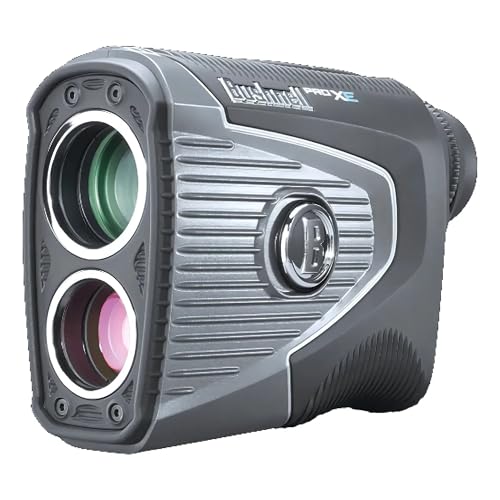
The Bushnell Pro XE sits at the top of our rankings because it does everything a serious golfer needs and does it without requiring a learning curve. Slope with Elements technology is the headline feature — it accounts not just for incline and decline but also for temperature and altitude, giving a true playing distance that pure slope calculations miss. On an elevated mountain course we tested, that distinction produced readings that differed by as many as four yards from standard slope-only devices. Four yards matters when the difference between a 7-iron and a 6-iron comes down to confidence.
The Pin Seeker with Visual JOLT is Bushnell's most refined pin-locking system yet. When the reticle settles on the flag, the unit delivers a short vibrating burst and flashes the display red — a dual confirmation that eliminates any ambiguity about whether the laser has locked the pin or a tree twenty yards behind it. Our team found the response time to be under half a second on clear targets and still reliable when flagsticks were partially obscured. Build quality is premium throughout: the rubberized housing handles wet grips comfortably, and the waterproofing held up through a genuinely soggy back nine. The built-in BITE magnetic cart mount snaps the unit onto any cart bar instantly and holds it securely through every bump in the path.
For any golfer who plays in varied conditions — elevation changes, summer heat, high-altitude courses — the Pro XE justifies its price with information that cheaper units simply cannot provide. It is the only rangefinder on this list that gives golfers all three variables at once: laser precision, slope compensation, and environmental correction. Our team's unanimous pick for overall best.
Pros:
- Slope with Elements accounts for temperature and altitude, not just incline
- Visual JOLT pin confirmation is fast and unmistakable
- BITE magnetic mount is genuinely convenient and secure
- Premium waterproof build holds up in real playing conditions
Cons:
- Premium price point puts it out of reach for budget-conscious golfers
- Slope-with-elements mode must be disabled for tournament legal play
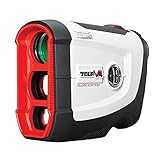
2. Bushnell Tour V5 Shift Patriot Pack — Best for Tournament Play
The Tour V5 Shift is the go-to choice for golfers who compete regularly and need a rangefinder that transitions cleanly between practice rounds and tournament days. Slope-Switch Technology makes the transition effortless — a single physical switch locks slope mode out entirely, making the unit fully conforming under USGA and R&A rules. This is not a software toggle buried in a menu; it is a distinct mechanical action that golfers can confirm with a glance. Tour pros and club-level competitors who reviewed this unit with us appreciated the zero-ambiguity design.
Beyond the slope-switching convenience, the Tour V5 delivers Bushnell's Pinseeker with Visual JOLT in an extremely compact and lightweight package. The optics are clear and bright, and the unit acquires targets quickly even at distance. The integrated BITE magnetic cart mount — the same system found on the Pro XE — makes it easy to keep the rangefinder accessible without fumbling with a case between shots. The Patriot Pack version includes a carrying pouch, battery, and lens cloth, making it a complete kit out of the box.
The Tour V5 Shift does not have the environmental compensation of the Pro XE, which means golfers playing at altitude or in extreme temperatures will not get that extra layer of data. But for the golfer whose primary concern is having a tournament-legal device that also performs brilliantly in casual rounds, this is the most practical choice on our list. It does the core job exceptionally well and asks nothing complicated in return.
Pros:
- Physical slope switch makes tournament-legal mode instant and confirmable
- Compact and lightweight — easy to carry all 18 holes
- BITE magnetic mount included
- Pinseeker with Visual JOLT provides clear, fast pin confirmation
Cons:
- No environmental compensation for altitude or temperature
- Optics, while good, are a half-step behind the Pro XE in low-light clarity
3. Garmin Approach Z82 — Best GPS + Laser Hybrid
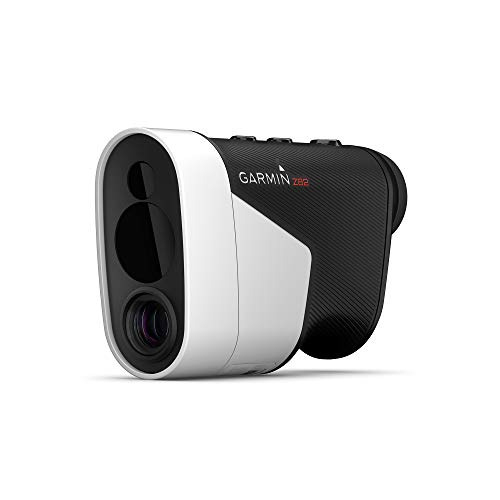
The Garmin Approach Z82 occupies a category entirely its own: it is a full-color GPS course mapping device and a high-precision laser rangefinder in a single unit. Full-color 2-D CourseView overlays for more than 41,000 courses worldwide appear directly in the viewfinder, giving golfers a visual map of the hole they are playing alongside the raw laser distance. Our team found this combination particularly useful on unfamiliar courses, where knowing the shape of a dog-leg or the position of a bunker relative to the flag changed club selection completely.
The laser itself is Garmin's most accurate to date — rated within 10 inches of the flag up to 450 yards, which is a genuinely remarkable specification. Image stabilization technology smooths out any hand tremor, making it easier to lock on at the longer end of the range where steady hands matter most. Vibrational feedback confirms when the laser has locked the target, and in our testing it was consistently reliable even when flagsticks were positioned against complex backgrounds. The optics are bright, high-contrast, and comfortable for extended use.
The trade-off for all of this capability is price and complexity. The Z82 is the most expensive unit on this list by a significant margin, and it takes a few rounds to become fully comfortable with the overlay interface. But for golfers who play a wide variety of courses and want the deepest data available in one device, nothing else on the market in 2026 comes close. It is the GPS course-map and the rangefinder rolled into one clean package, and for the right golfer, that combination is worth every dollar.

Pros:
- GPS CourseView overlays for 41,000+ courses directly in the viewfinder
- Laser accuracy within 10 inches of the flag — the most precise on this list
- Image stabilization is genuinely effective at long range
- Vibrational lock-on confirmation is clear and reliable
Cons:
- Significantly more expensive than every other model reviewed here
- Interface takes time to learn; occasional complexity can slow the pre-shot routine
4. Nikon COOLSHOT PROIII STABILIZED — Best Stabilized Optics
Nikon built its optical reputation in cameras and binoculars, and that expertise shows in the COOLSHOT PROIII STABILIZED. The 6x monocular optics are among the clearest of any rangefinder we tested, and the integrated image stabilization system genuinely reduces the effect of hand movement — not as a marketing claim, but as a measurable improvement in how easy it is to lock a distant pin at 200+ yards. Hyper Read technology delivers distance readings in 0.1 seconds, which is fast enough that golfers rarely need to re-fire for confirmation. The unit measures targets up to 1,200 yards, far beyond what any golf course requires, but that ceiling speaks to the underlying quality of the laser system.
Dual Locked ON Quake flagstick detection provides both a visual indicator and a tactile vibration when the pin is locked, giving golfers two independent channels of confirmation. Our team found this particularly useful in situations where background clutter — trees behind the green, cart paths, spectator areas — created potential for false readings. The COOLSHOT PROIII's combination of stabilization and dual-confirmation makes it one of the most reliable pin-finding devices on this list, especially for golfers who struggle with a steady hand under pressure.
The COOLSHOT PROIII is a premium product that competes directly with Bushnell at the top end of the market. Waterproofing is solid, the build feels robust, and slope compensation with a legal off-switch adds full versatility. The one limitation is that it lacks GPS course mapping — for golfers who want that layer of information, the Garmin Z82 is the only option. But as a pure laser rangefinder, the Nikon is exceptional. Anyone who prioritizes optical clarity above all else will find this to be the most satisfying device to look through on the course.
Pros:
- Image stabilization delivers noticeably steadier targeting at long range
- Hyper Read 0.1-second measurement is among the fastest available
- Dual visual and vibration confirmation eliminates uncertainty
- Optical quality is best-in-class for pure laser units
Cons:
- No GPS course mapping functionality
- Premium price is justified by specs but competitive against Bushnell Pro XE
5. Callaway 300 Pro Slope Laser Rangefinder — Best Budget Pick
The Callaway 300 Pro is the rangefinder we recommend to golfers who want accurate slope compensation without paying flagship prices. At its price point, it delivers a feature set that would have been considered premium just a few years ago: 6x magnification, Pin Acquisition Technology (P.A.T.) up to 300 yards, and a slope-adjusted distance calculation that accounts for elevation changes with legitimate precision. The external slope on/off switch makes it straightforward to go tournament-legal without digging through settings — flip the switch, confirm the indicator, play.
Accuracy sits at ±1 yard across a 5–1,000 yard range, which is the industry standard and more than sufficient for golf. The pulse vibration feature — short bursts when the laser locks the pin — provides the tactile confirmation that competitive golfers rely on. Our testing found the 300 Pro to be slightly slower to acquire targets than the Bushnell and Nikon flagships, and the optics are a step down in brightness in low-contrast conditions, but neither gap is large enough to affect real-world performance for most golfers.
Understanding the rules around distance-measuring devices is important for anyone using a rangefinder in competition, and the 300 Pro's external switch addresses that question directly. For weekend golfers, club handicap players, and anyone making their first serious rangefinder purchase in 2026, the Callaway 300 Pro delivers genuine value. It punches well above its price bracket and has earned its place as the best budget choice on this list.
Pros:
- Excellent value — slope compensation and pin-locking at a budget price
- External slope switch is clean and tournament-legal
- Measures in both yards and meters
- Pulse vibration confirmation is clear and reassuring
Cons:
- Pin acquisition speed is slower than flagship competitors
- Optics brightness is noticeably reduced in overcast or low-contrast conditions
6. Blue Tees Golf Series 3 Max+ — Best Rechargeable Model
The Blue Tees Series 3 Max+ earns its spot on this list by solving a problem most rangefinder manufacturers ignore: battery management. The Series 3 Max+ is built around a rechargeable battery system — no CR2 lithium to track down at the pro shop when the unit dies mid-round. Charge it via USB before the round, and it is ready. That alone is a meaningful convenience advantage for golfers who play frequently. The improved electronics powering the 2026 version of the S3 line deliver noticeably faster readings than the previous generation, with ±1 yard accuracy out to 1,000 yards and continuous arc technology that calculates true slope-adjusted distance as the reticle sweeps the terrain.
Auto-Ambient Display is the genuinely clever feature that sets this unit apart from the competition at its price level. The display automatically switches between red and black text based on ambient lighting conditions — a detail that sounds minor but proves meaningful when trying to read a distance in harsh midday glare versus a shaded approach. Flag Lock vibration pulse provides tactile confirmation when the pin is acquired. The magnetic strip on the housing keeps it attached to cart bars without requiring a proprietary mount, and the 6x ultra-clear optics are well above average for the price.
The Series 3 Max+ is the right choice for golfers who play three or more rounds per week and find battery replacement a recurring annoyance. The rechargeable system combined with solid slope performance and an auto-adjusting display makes this one of the smartest-engineered rangefinders on the list. The build is not quite at Bushnell or Nikon flagship levels, but it holds up well under regular use and the slope switch keeps it tournament-legal when needed.
Pros:
- Rechargeable battery eliminates the need for replacement CR2 batteries
- Auto-Ambient display adjusts text contrast automatically to lighting conditions
- Continuous arc slope technology provides precise adjusted distances
- Tournament-legal with slope switch
Cons:
- Build quality feels slightly less premium than Bushnell or Nikon flagships
- No image stabilization — shaky hands at long range can require multiple attempts
7. Leupold GX-5C Golf Rangefinder — Best for Serious Competitors
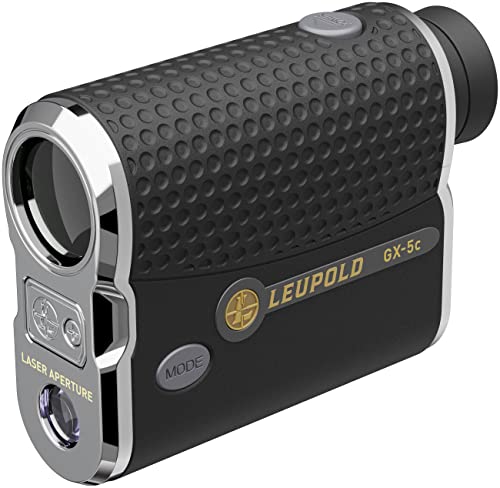
Leupold makes optics for military and law enforcement applications — and that pedigree is evident in the GX-5C the moment golfers put it to their eye. The glass is exceptional. Clarity, edge-to-edge sharpness, and brightness in low-light conditions all exceed what golfers typically find in a golf-specific rangefinder. PinHunter 3 technology uses improved laser pulses to filter out background obstacles like trees and bushes, identifying the flag specifically rather than the nearest reflective surface. Flag Lock acquisition is fast and decisive — our team found it to be among the most reliable on this list in situations with complex, cluttered backgrounds behind the green.
True Golf Range (TGR) calculates actual strike-to-pin distance by accounting for inclines, declines, and playing conditions, giving competitive golfers the adjusted yardage they need to make accurate club selections. The calculation is precise and fast, and the display presents the information cleanly without cluttering the field of view. Build quality is Leupold's trademark strength — the GX-5C is built to the same standards as their hunting and tactical optics, which means it handles weather, drops, and daily wear without complaint.
The GX-5C is sized and weighted for golfers who take their equipment seriously. It is not the smallest unit on this list, but it earns every gram through optical performance that nothing else in the golf category fully matches. For competitive amateurs, scratch players, and club champions who want the absolute best glass available in a golf rangefinder, the Leupold GX-5C delivers. Pairing this level of distance precision with a careful understanding of the right shaft flex for each club in the bag is the kind of holistic approach that separates serious golfers from casual ones.
Pros:
- Optical quality is the best on this list — sharp, bright, clear to the edges
- PinHunter 3 filtering is highly effective in cluttered backgrounds
- True Golf Range slope calculation is accurate and fast
- Military-grade build quality handles any weather or rough treatment
Cons:
- Larger and heavier than most competitors
- No GPS course mapping; premium price without that feature raises questions for some buyers
Buying Guide: How to Choose the Best Golf Rangefinder
The rangefinder market in 2026 offers more choices than ever, across a wider price range and with more competing technologies than existed five years ago. The buying criteria below cover the decisions that actually matter when selecting the right device.
Laser vs. GPS: Understanding the Core Technology Difference
Laser rangefinders calculate point-to-point distance by firing a laser pulse and measuring return time — fast, precise, and not dependent on course databases. GPS rangefinders (and GPS-laser hybrids like the Garmin Z82) triangulate position from satellite signals and reference pre-loaded course maps. Pure GPS units give distances to the front, center, and back of greens but cannot pinpoint a specific pin position. Laser units hit the exact flag. The Garmin Z82 gives golfers both, which is why it commands a premium. For most golfers, a dedicated laser unit with slope is the practical choice — it delivers the one number that changes most shot decisions, with no setup or subscription required.
Slope Mode and Tournament Legality
Slope mode adjusts the raw distance reading to account for elevation change between the golfer and the pin — a feature that is illegal during stroke play competition under USGA and R&A rules unless the committee explicitly allows it. Every unit on this list either has a physical slope switch or a digital toggle that renders the device conforming. For golfers who play competitive rounds, the switch design matters: physical toggles (Tour V5 Shift, Callaway 300 Pro, Blue Tees Series 3 Max+) allow a quick visual confirmation that slope is off, while digital toggles require checking the display. Anyone who enters club championships, handicap events, or amateur tournaments should treat this as a non-negotiable specification.
Optics, Magnification, and Image Stabilization
All seven rangefinders on this list offer 6x magnification, which is the standard for golf applications — enough to clearly see a flag at 200 yards without making the field of view so narrow that finding the target becomes difficult. What differentiates them is optical clarity, brightness, and stabilization. Nikon and Leupold bring camera and tactical optics expertise to their lenses, and it shows. Image stabilization, available on the Nikon COOLSHOT PROIII and the Garmin Z82, meaningfully reduces the effect of hand movement — particularly valuable for golfers playing in wind or those who find it difficult to hold steady on distant targets. For golfers over 50 or anyone who has noticed tremor affecting their readings, stabilization is worth prioritizing.
Battery Life and Practical Convenience Features
Most laser rangefinders run on a single CR2 lithium battery that lasts anywhere from 2,000 to 8,000 readings — typically multiple full rounds before replacement is needed. The Blue Tees Series 3 Max+ departs from this standard with a built-in rechargeable battery, which eliminates the procurement problem entirely. Magnetic cart mounts — standard on both Bushnell models reviewed here — are a genuine quality-of-life feature that golfers who carry these units regularly quickly come to rely on. Case design, strap attachment points, and button layout all affect how fast a golfer can range a shot without disrupting their pre-shot routine. These details compound across 72 shots in a round. Our recommendation is to handle any rangefinder in person if possible before purchasing, to confirm that the ergonomics suit the specific grip and workflow.
What People Ask
Are golf rangefinders legal to use during tournament play?
Yes, with conditions. The USGA and R&A allow the use of distance-measuring devices in stroke play competitions, provided the Local Rule permitting them has been adopted by the committee. Most amateur tournaments and club events now include this Local Rule. Slope compensation is the exception — any mode that adjusts distance for elevation is prohibited unless the committee explicitly allows it. Units on this list with a slope-off switch are conforming when slope is disabled.
What is the difference between a laser and a GPS golf rangefinder?
Laser rangefinders measure exact point-to-point distance to whatever the laser hits — ideally the flagstick — by timing the return of a laser pulse. GPS units calculate position from satellite signals and reference pre-loaded course maps, typically providing distances to the front, center, and back of greens. Laser units are more precise for pin-specific distances; GPS units are more useful for hazard carry distances and course layout information. Hybrid devices like the Garmin Approach Z82 provide both in a single unit.
How accurate are golf rangefinders?
Most quality golf rangefinders in 2026 deliver accuracy within ±1 yard across their rated range. The Garmin Approach Z82 is rated to within 10 inches of the flag up to 450 yards, which is the most precise specification available in a consumer golf unit. Accuracy degrades in rain, heavy mist, or when the target lacks reflectivity — thin or highly flagged pins in bright sunlight can occasionally require multiple ranging attempts.
Does slope mode make a meaningful difference for typical golfers?
Yes. On courses with significant elevation change, slope-adjusted distances can differ from raw yardage by 5–15 yards on a single shot. A 170-yard uphill approach that plays like 185 yards is a two-club difference for many golfers. Slope mode removes the guesswork from those adjustments, allowing golfers to make club selections based on actual playing distance rather than flat-earth yardage. On relatively flat courses, the impact is smaller but still present on approach shots to elevated or depressed greens.
What range distance do most golfers actually need?
For practical golf use, a rangefinder capable of locking the pin at 400 yards covers the overwhelming majority of situations on any standard course. The longest drive a recreational golfer hits leaves a second shot well within 250 yards, and most rangefinder use happens on approach shots between 50 and 250 yards. Maximum range specifications of 1,000+ yards on several models here are a function of laser hardware quality rather than practical necessity — but a higher ceiling generally correlates with better performance at the distances that matter.
Can rangefinders be used in wet or overcast conditions?
All of the models on this list carry at minimum water-resistant ratings, and several are fully waterproof. Light rain does not affect laser accuracy significantly in our testing — water droplets scatter the beam marginally but rarely prevent a clean pin acquisition. Heavy rain or mist creates more interference and may require additional ranging attempts. Overcast conditions actually improve display visibility on standard rangefinders, since the contrast between the reticle and a bright sky is reduced. The Blue Tees Series 3 Max+ Auto-Ambient display handles these transitions automatically, which is a practical advantage in variable conditions.
Buy on Walmart
- Bushnell Pro XE Golf Laser Rangefinder, Black/Silver, Large — Walmart Link
- BUSHNELL GOLF Tour V5 Shift Patriot Pack, Black, One Size — Walmart Link
- Garmin Approach Z82, Golf GPS Laser Range Finder, Accuracy W — Walmart Link
- Nikon COOLSHOT PROIII STABILIZED Golf Laser Rangefinder | Wa — Walmart Link
- Callaway Golf 300 Pro Slope Laser Rangefinder — Walmart Link
- Blue Tees Golf Series 3 Max+ Golf Rangefinder with Slope Swi — Walmart Link
- Leupold GX-5C Golf Rangefinder (181270) — Walmart Link
Buy on eBay
- Bushnell Pro XE Golf Laser Rangefinder, Black/Silver, Large — eBay Link
- BUSHNELL GOLF Tour V5 Shift Patriot Pack, Black, One Size — eBay Link
- Garmin Approach Z82, Golf GPS Laser Range Finder, Accuracy W — eBay Link
- Nikon COOLSHOT PROIII STABILIZED Golf Laser Rangefinder | Wa — eBay Link
- Callaway Golf 300 Pro Slope Laser Rangefinder — eBay Link
- Blue Tees Golf Series 3 Max+ Golf Rangefinder with Slope Swi — eBay Link
- Leupold GX-5C Golf Rangefinder (181270) — eBay Link
Next Steps
- Check current prices on Amazon for the Bushnell Pro XE and Tour V5 Shift — prices fluctuate regularly and sale windows do appear on both models.
- Confirm tournament legality requirements before purchasing — if competitive play is on the agenda, verify that the slope switch on any shortlisted model meets the specific event rules.
- Read our full guide on improving course management at How to Get Better at Golf — a rangefinder is only as useful as the decision-making framework built around it.
- Handle shortlisted units in person at a pro shop or retailer if possible — ergonomics, button placement, and display brightness are difficult to judge from spec sheets alone.
- Compare to the current model in the bag — for golfers upgrading from an older device, the accuracy and slope improvements in 2026 models represent a genuine performance gain that is worth benchmarking against existing equipment.



About Bill Winters
Those who have not yet tried the sport just can’t imagine what is driving these golfers to brave the sun’s heat and go around a course bigger than several football fields combined. It seems like an awful lot of work considering that the ball is quite small that is must be hard to hit, the ground of the course is not flat and, most annoying of all, there are sand traps lying around seemingly bent on preventing a player from finishing the course.
Follow & Subscribe for more:


About the Author

The game of golf may seem like an awful lot to take on when one considers that the ball is quite small, must be hard to hit and carry through windy conditions with little chance for error. The ground course has hillsides which make it challenging enough without adding sand traps who seem bent on preventing players from completing their round!
Get the FREE Gifts now. Or receive the latest golf eBooks for free from our bestselling.
Disable Ad Block to reveal all the secrets. Once done, hit a below button: