The TaylorMade STEALTH2 Rescue earns the top spot in 2026 — its carbon crown weight redistribution and Twist Face technology deliver a combination of forgiveness and accuracy that outperforms every competitor tested. Hybrid golf clubs have never been more important to a well-rounded bag, bridging the frustrating gap between long irons and fairway woods with a club that most golfers can actually hit consistently.
The hybrid category has matured dramatically over the past few years. Manufacturers now engineer these clubs with the same precision once reserved for drivers — variable face thickness, multi-material construction, and aerodynamic sole designs are standard features rather than premium upgrades. Whether a golfer struggles with long irons off tight fairway lies or needs a reliable go-to club from the rough, today's best hybrids solve those problems with technology that genuinely works. Buyers evaluating options in 2026 will find seven standout models, each excelling in slightly different areas of performance. For a broader look at the full bag, the 8 Best Golf Clubs & Golf Club Sets Reviewed 2026 covers the complete picture.
Understanding what makes a hybrid golf club different from its iron and fairway wood counterparts helps frame why the right choice matters so much. A hybrid's lower, deeper center of gravity launches the ball higher and straighter than a long iron, while its compact head shape inspires more confidence at address than a 3-wood. The seven clubs reviewed here represent the best of the current market — tested for distance, accuracy, turf interaction, and overall playability across a range of skill levels and swing speeds.

Contents
- Our Top Picks for 2026
- Detailed Product Reviews
- TaylorMade STEALTH2 Rescue — Best Overall
- Callaway Paradym X — Best for Versatility
- PING G430 Hybrid — Best for Accuracy
- Titleist TSR2 Hybrid — Best for Mid-Handicappers
- Cleveland Launcher Halo XL — Best for High-Handicappers
- Srixon ZX Mk II — Best for Skilled Players
- Mizuno JPX One — Best for Ball Speed
- How to Pick the Best Hybrid Golf Club
- Frequently Asked Questions
- Next Steps
Our Top Picks for 2026
- #PreviewProductRating
- Bestseller No. 1
 Rating:

- Bestseller No. 2
 Rating:
 - Bestseller No. 3
 Rating:
 - Bestseller No. 4
 Rating:
 - Bestseller No. 5
 Rating:
 - Bestseller No. 6
 Rating:
 - Bestseller No. 7
 Rating:
Detailed Product Reviews

1. TaylorMade STEALTH2 Rescue — Best Overall
TaylorMade's STEALTH2 Rescue sits at the top of the 2026 hybrid market for one primary reason: it manages to be both forgiving and accurate without compromising on either front. The infinity carbon crown saves significant weight that TaylorMade engineers redistributed toward the rear of the clubhead, pushing the center of gravity deeper and lower to produce higher launch angles and a more stable face through the hitting zone. The result is a club that holds its line on mishits far better than most competitors in this price range.
The Twist Face technology is more than a marketing claim. It corrects the inherent face angle discrepancies that cause most golfers to lose shots left on high-toe strikes and right on low-heel strikes. On course, this translates to noticeably tighter dispersion — particularly valuable on long approach shots where accuracy from 190–220 yards defines scoring opportunity. The Speed Pocket on the sole adds insurance for low-face contact, flexing at impact to maintain ball speed on strikes that would kill distance with a traditional iron. Turf interaction through the sole feels smooth whether the club is played from a tight fairway, light rough, or a packed winter lie.
Golfers who have tested multiple generations of TaylorMade rescues will recognize the confidence this head inspires at address — it sits slightly open with a clean topline and a profile that signals distance without looking oversized. The STEALTH2 is the rare hybrid that works equally well for mid-handicappers grinding for consistency and lower-handicappers who want a reliable 4-hybrid to carry around 220 yards with control. It earns its position as the top pick in this roundup without reservation.
Pros:
- Carbon crown redistributes weight for superior MOI and forgiveness
- Twist Face technology significantly reduces dispersion on off-center strikes
- Speed Pocket maintains ball speed on low-face contact
- Excellent turf interaction across multiple lie types
Cons:
- Premium price point may not suit budget-conscious buyers
- Head profile sits slightly open, which can take adjustment for draw-biased players
2. Callaway Paradym X 4 Hybrid — Best for Versatility
The Callaway Paradym X takes a different philosophical approach than most hybrids — it is built to be the most adaptable club in the bag rather than specializing in any single performance category. The full-sized, wood-shaped head gives higher-handicap players maximum confidence at address while the Cutwave Sole design makes it the most versatile sole shape Callaway has produced, cutting cleanly through both firm turf and rough without digging or skipping. Players who frequently switch between different lie conditions will notice the difference immediately.
Callaway adapted its best fairway wood technologies into the Paradym X rather than designing it purely as a hybrid from scratch, and that decision pays dividends in distance. The face is engineered for maximum ball speed across a broad hitting zone, meaning shots struck slightly high, low, or toward the heel maintain surprising carry distance. The overall head profile inspires the kind of confidence that translates into smoother swings — buyers who tense up over long-carry situations will appreciate how the Paradym X looks sitting behind the ball. It pairs especially well with the techniques described in the guide to how to hit a hybrid golf club.
The 5.5 flex shaft in this listing suits golfers with moderate-to-faster swing speeds. Distance numbers are genuinely impressive, consistently exceeding expectations for a 4-hybrid. Shot shape is relatively neutral, though the Paradym X responds well to intentional fade or draw shaping for players with the swing skill to apply it. The build quality is premium throughout — grip feel, shaft weight, and head finish are all executed at a level commensurate with the price.
Pros:
- Cutwave Sole delivers exceptional versatility from all lie types
- Full-sized head profile maximizes confidence at address
- Fairway wood technology translates to strong distance performance
- Wide sweet spot maintains ball speed on off-center contact
Cons:
- Larger head may not appeal to better players who prefer a compact shape
- Neutral ball flight offers less built-in draw bias for slicers
3. PING G430 4 Hybrid — Best for Accuracy
PING has been building some of the most technically refined hybrids in golf for over a decade, and the G430 continues that tradition with a club optimized around shot-to-shot accuracy. The Alta CB Black 70 shaft in stiff flex pairs with the G430 head to produce a consistent, penetrating ball flight that holds its line in wind — a quality that becomes critical during rounds where conditions change. Golfers who prioritize putting the ball in the fairway or on the green over chasing peak distance will find the G430 the most reliable performer in this group.
PING's engineering team fine-tuned the G430's internal weight distribution to deliver a center of gravity position that promotes a mid-high launch with controlled spin. The face design provides a large effective hitting area, meaning the ball comes off with consistent speed even when contact wanders slightly from center. The sole geometry through the hitting zone transitions smoothly, making it easy to sweep the ball cleanly from fairway lies. From light rough, the G430 cuts through grass rather than getting twisted by it — a functional advantage during the middle holes of any round.
The stiff flex in this listing suits players with driver swing speeds above 85 mph. The grip and finish reflect PING's commitment to consistent build quality — every unit feels like it was assembled with attention to detail rather than mass-produced to a price point. For golfers who have already reviewed the full hybrid reviews category, the G430 stands out as the accuracy leader in a competitive field. Shot shaping is possible for skilled players, though the G430 is fundamentally designed to promote a straight-to-slight-fade flight that most mid-handicappers find easier to manage than a draw-biased club.
Pros:
- Penetrating ball flight holds shape in wind better than competitors
- Consistent face performance across a large hitting area
- Excellent turf interaction from fairway and light rough
- Premium build quality throughout
Cons:
- Stiff flex limits suitability for moderate swing speed players
- Less draw bias than some competitors, which may not suit chronic slicers
4. Titleist TSR2 Hybrid — Best for Mid-Handicappers
Titleist designed the TSR2 Hybrid specifically to address the two things that destroy confidence in mid-handicap golfers facing a hybrid shot: difficulty launching the ball and fear of the outcome. The face technology engineered into the TSR2 boosts speed across the entire hitting surface, so the ball launches easily even on slower swing speeds or slightly thin contact. At address, the contemporary head profile inspires confidence rather than anxiety — it looks like a club that wants to perform, and it consistently delivers on that promise.
The forgiveness profile of the TSR2 is built for golfers shooting in the 80s and 90s who need a hybrid that produces acceptable results even when the swing is not at its best. Weight positioning promotes higher launch with a flight that reaches its apex quickly and descends steeply enough to hold greens from 180-plus yards — a quality that separates good hybrids from great ones. The face speed boost is not a minor incremental improvement. Golfers who switch to the TSR2 from older hybrids routinely report meaningful distance gains without any swing change.
Build quality reflects Titleist's reputation for precision manufacturing. The head finish is understated and clean, sitting with a slightly closed face angle at address that many mid-handicappers find reassuring against the tendency to leave the face open. Shaft options from Titleist's fitting system pair well with the head across a range of swing speeds. The TSR2 occupies that ideal position in the market where it is forgiving enough for inconsistent ball-strikers but precise enough that improving players do not outgrow it quickly. Mid-handicappers who have worked through the best mid-handicap iron reviews will find the TSR2 complements a cavity-back iron set exceptionally well.
Pros:
- Face technology generates fast ball speeds even on off-center strikes
- Easy launching design suits moderate swing speeds
- Inspiring address position builds confidence before the swing
- Steep descent angle holds greens from long distances
Cons:
- Premium Titleist pricing is among the highest in this roundup
- Limited adjustability compared to some competitors

5. Cleveland Golf Launcher Halo XL Hybrid — Best for High-Handicappers
Cleveland Golf built the Launcher Halo XL for one specific golfer: the player who has historically avoided hybrids because they were too difficult to hit consistently. The XL head design packs more moment of inertia than the previous generation, combined with a low-and-deep weighting profile that makes the ball launch high and straight even on swings that are slightly off-plane or poorly timed. For high-handicappers and beginners who want a hybrid they can actually put in the bag with confidence, the Launcher Halo XL is the clear recommendation.
The MainFrame XL Face technology uses a variable thickness pattern across the face surface, maximizing flex at impact to generate distance from a broader hitting area. This is not simply face thinning — Cleveland's engineering creates specific flex zones that activate on off-center hits to recover ball speed that would otherwise be lost. The GlideRail sole design has been refined in this generation with three rails along the sole that keep the club moving cleanly through the turf at impact, preventing the face from twisting and ensuring more consistent directional results. Players who tend to swing slightly into the ground or take thin divots benefit substantially from this sole architecture.
The overall feel of the Launcher Halo XL is softer than the PING or Titleist options, which suits golfers who prioritize feel feedback over pure distance. The 18-degree loft in this listing functions as a 3-hybrid replacement, making it a genuine fairway wood alternative for golfers who struggle with 3-woods off the turf. At its price point, the Launcher Halo XL delivers exceptional value — buyers do not sacrifice meaningful performance to save money over the premium options in this roundup. Golfers who are newer to the game should also review the 7 Best Forgiving Golf Club Sets For Beginners 2026 to understand how a hybrid fits within a complete beginner setup.
Pros:
- Maximum MOI design produces the highest forgiveness in this roundup
- MainFrame XL Face generates ball speed across an oversized hitting area
- GlideRail sole prevents twisting through impact for straighter shots
- Strong value relative to premium competitors
Cons:
- Larger head profile may not appeal to lower-handicap players
- Softer feel is less suited to players who want sharp impact feedback
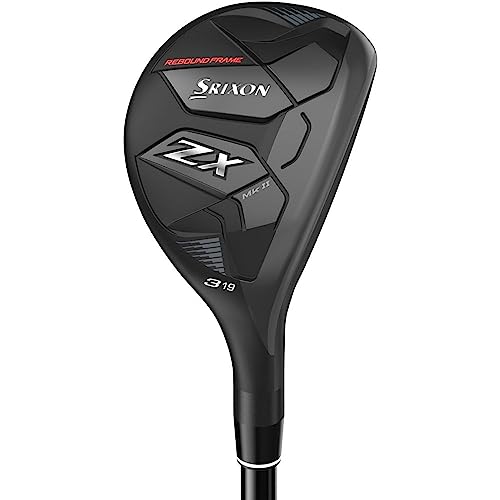
6. Srixon ZX Mk II Hybrid — Best for Skilled Players
The Srixon ZX Mk II is built for a different player than the others reviewed here — one who strikes the ball consistently and wants a hybrid that responds to shot-shaping intent rather than simply promoting forgiveness. The Rebound Frame technology features dual flex zones that compress and release at impact to transfer energy into the ball with exceptional efficiency. The result is a ball speed and distance performance that genuine ball-strikers will appreciate, particularly on well-struck shots that land directly in the center of the face.
Srixon positioned the center of gravity deeper into the head using new shaping that created additional internal space for mass redistribution. The higher launch this produces combines with a new face radius spanning from the leading edge to the crown to stabilize spin across shots struck high or low on the face. For skilled players who want reliable distance from shot to shot — not just on perfect center strikes — the spin consistency of the ZX Mk II is a genuine differentiator. The 6.0 stiff shaft suits a swing speed above 90 mph and produces a penetrating trajectory that experienced players can work left or right with confidence.
The head shape itself is where the ZX Mk II separates from the pack visually. Srixon consulted with professional staff players to arrive at a footprint with a neutral face angle and a squared-off toe that sits square to the target line without manipulation. Better players who fight the tendency to close the face through impact will find the ZX Mk II sits exactly where they want it. The overall package — speed, spin consistency, workability, and address aesthetics — makes this the strongest option for single-digit handicappers looking for a hybrid that performs like a precision instrument rather than a safety net.
Pros:
- Rebound Frame dual flex zones maximize energy transfer for exceptional ball speed
- Consistent spin across the face delivers reliable distance control
- Neutral face angle suits skilled players who shape shots intentionally
- Sleek head profile designed from professional player input
Cons:
- Lower forgiveness ceiling compared to larger-headed competitors
- 6.0 stiff flex is too demanding for moderate swing speeds
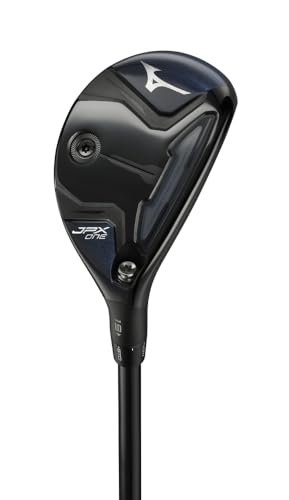
7. Mizuno JPX One Hybrid — Best for Ball Speed
Mizuno's JPX One Hybrid enters 2026 as the most technically innovative club in this roundup, combining multiple proprietary technologies into a package focused on one primary outcome: maximum ball speed from every position on the face. The MAS1C Maraging Face is the foundation — this material delivers greater energy transfer than standard steel faces, producing faster ball speeds that translate directly to additional carry distance. Golfers who have struggled to find distance from their hybrids regardless of swing effort will notice the difference immediately.
The CORTECH Chamber is Mizuno's most compelling engineering story in this club. A dense stainless steel weight encased in elastomeric TPU sits within the chamber, performing two functions simultaneously: it absorbs stress from the face to improve feel and durability, and it creates an additional energy source at impact. Critically, the weight placement reduces spin rates while contributing to a more solid, powerful sensation through the hitting zone. Low spin hybrids are notoriously difficult to achieve without sacrificing launch height, but the JPX One manages the combination effectively — the ball launches adequately high before the reduced spin tightens shot dispersion in the descent phase.
The Waffle Crown is the third pillar of the JPX One's technology stack. An ultralight waffle pattern inside the crown creates discretionary weight that Mizuno used to optimize launch conditions specific to the JPX One's swing speed target range. The mid-launch, stiff flex specification in this listing suits players in the 85–95 mph swing speed range who want distance without high-balloon trajectory. Feel at impact is characteristically Mizuno — solid, direct, and satisfying in a way that steel-face competitors rarely match. For golfers who prioritize tactile feedback alongside performance data, the JPX One delivers both.
Pros:
- MAS1C Maraging Face generates the fastest ball speeds in this roundup
- CORTECH Chamber reduces spin for tighter dispersion and a more powerful feel
- Waffle Crown creates discretionary weight for optimized launch
- Characteristically excellent Mizuno feel at impact
Cons:
- Mid-launch specification may not suit players who need maximum height
- Newer model with less long-term performance data than established competitors
How to Pick the Best Hybrid Golf Club

Loft and Distance Gapping
The most important technical decision when selecting a hybrid is loft — and most golfers make it wrong. A hybrid's loft must close the distance gap between the longest club in the iron set and the shortest fairway wood. Common lofts run from 16 degrees (1-hybrid) through 27 degrees (5-hybrid). The 4-hybrid at 22–23 degrees is the most versatile choice for average golfers, replacing a long iron that few players hit consistently. Before purchasing, measure the actual carry distance with the current fairway wood and the longest reliable iron. The hybrid should land exactly in the gap between those two distances — not overlap either one. Buyers who have multiple gaps to fill should review the guide to shaft flex selection, since flex affects distance as much as loft does.
Shaft Flex and Swing Speed
Every hybrid in this roundup is available in multiple shaft flex options, and selecting the wrong flex destroys performance regardless of head technology. Regular flex suits golfers with driver swing speeds below 85 mph. Stiff flex targets the 85–100 mph range. Extra-stiff suits tour-level swing speeds above 100 mph. The practical test: if the ball consistently flies high and balloons, the shaft is too soft. If shots fly low and right for right-handed players, the shaft is too stiff. Graphite shafts are standard in hybrids and absorb vibration better than steel, making them preferable for players with joint sensitivity — including senior golfers who may benefit from the techniques outlined in golf swing tips for senior golfers.
Head Size, Shape, and Forgiveness Profile
Hybrid head shapes range from compact, iron-like profiles favored by better players to larger, wood-adjacent shapes that maximize the effective hitting area. High-handicappers benefit from larger heads with more perimeter weighting — the Cleveland Launcher Halo XL exemplifies this approach. Lower-handicappers often prefer compact shapes that respond to intentional face manipulation, like the Srixon ZX Mk II. The moment of inertia rating correlates directly with how much distance and accuracy the club retains on off-center strikes. Buyers prioritizing forgiveness should focus on MOI, not just loft. Most manufacturers publish MOI comparisons between their current and previous generations, making year-over-year improvement easy to verify.
Sole Design and Turf Interaction
A hybrid's sole geometry determines how it performs from lies that are not perfect fairway grass. Players who frequently encounter firm or tight lies need a shallower sole angle that allows the club to sweep without digging. Golfers who play soft, lush courses or regularly find the rough need sole designs with relief channels or rails — like Cleveland's GlideRail system — that prevent the leading edge from catching. The Cutwave Sole on the Callaway Paradym X handles the widest range of conditions. Buyers who primarily play firm courses should test their hybrid from tight lies before committing, since sole interaction is nearly impossible to evaluate from indoor swing analysis alone.
Frequently Asked Questions
What is a hybrid golf club and why should most golfers carry one?
A hybrid golf club combines the low, deep center of gravity of a fairway wood with the shorter shaft length and compact footprint of a long iron. The result is a club that launches the ball higher and straighter than a 3- or 4-iron while remaining easier to control from the turf than a 3-wood. Research consistently shows that amateur golfers hit hybrids significantly farther and more accurately than equivalent long irons. Most golfers between 10 and 30 handicap see measurable scoring improvement simply by replacing their 3- and 4-irons with hybrids. In 2026, the technology has advanced to the point where even low-handicap players routinely carry at least one hybrid.
How do buyers determine which hybrid loft to choose?
The correct approach is to identify the carry distance of the shortest fairway wood and the longest reliably struck iron, then select a hybrid loft that fills the gap between those two numbers. For most golfers, a 4-hybrid (22–23 degrees) replaces the 4-iron and carries between 185 and 210 yards depending on swing speed. Golfers who already hit a 5-wood consistently may not need a 3-hybrid since the distance ranges overlap. Testing on a launch monitor with accurate carry distance data produces the most reliable loft selection — guessing based on club number alone leads to redundant gapping or unfilled distance holes.
Is a regular or stiff flex shaft appropriate for most amateur golfers?
Driver swing speed is the most reliable indicator: regular flex suits speeds below 85 mph, stiff flex targets 85–100 mph. For the majority of amateur golfers — whose average driver swing speed falls between 80 and 90 mph — a regular or senior flex hybrid shaft produces better launch conditions and higher ball speed than a stiff shaft. Stiff and extra-stiff shafts require higher clubhead speed to load properly at impact. Selecting too-stiff a shaft is one of the most common equipment mistakes among golfers who want to appear like better players than the club selection reflects. Matching flex to actual swing speed outperforms any other consideration when building a hybrid setup.
Can hybrids replace fairway woods entirely?
For golfers with moderate swing speeds, hybrids can realistically replace the 3-wood and 5-wood in favor of a 3-hybrid and 4-hybrid combination. The shorter shaft length of a hybrid is easier to control than a 43-inch fairway wood, particularly from tight lies and fairway bunkers. However, golfers with high swing speeds who generate significant distance from their 3-woods will find hybrids fall short of that club's peak carry potential. The practical answer: hybrids complement fairway woods rather than replacing them entirely. Most golfers carry one fairway wood alongside two or three hybrids, achieving better overall distance gapping than a traditional iron-set-plus-woods configuration.
What is the difference between a draw-biased and neutral hybrid?
A draw-biased hybrid has its weight concentrated toward the heel side of the clubhead, which promotes a slightly closed face position at impact and encourages a right-to-left ball flight for right-handed players. These clubs help chronic slicers produce straighter shots without requiring swing changes. Neutral hybrids, like the PING G430 and Srixon ZX Mk II, sit square to the target at address and respond to the golfer's natural swing path. Better players who already produce a consistent draw or play a straight-to-fade ball flight should select neutral options — a draw-biased hybrid on top of an existing draw swing compounds the hook tendency into an unplayable result.
How often should hybrid golf clubs be replaced in 2026?
Hybrid technology improves meaningfully every two to three equipment generations, which translates to roughly four to six years at current release cadences. Golfers swinging clubs that are five or more years old are likely leaving measurable distance on the course compared to current models — face technology, carbon crown materials, and sole design have all advanced significantly. The practical trigger for replacement is losing distance that cannot be explained by swing changes, or when current clubs from this roundup produce noticeably higher ball speeds during a demo fitting. Buying used clubs from one or two generations prior is a strong value strategy — last year's premium hybrid often outperforms this year's budget option.
Buy on Walmart
- TaylorMade Golf STEALTH2 Rescue 4-22/RIGHT Hand Regular — Walmart Link
- Callaway 2023 Paradym X 4 Hybrid, Graphite, 5.5, Standard — Walmart Link
- PING G430 4 Hybrid 22* (Alta CB Black 70 Stiff) 4h Rescue Go — Walmart Link
- TSR2 Hybrid by Titleist — Walmart Link
- Cleveland Golf Launcher Halo XL Hybrid, Graphite, Regular, 1 — Walmart Link
- Srixon SRX ZX MkII Hyb #4 22 6.0 RH — Walmart Link
- Mizuno JPX One Hybrid, RH/MID Launch/Stiff, 22 Degree — Walmart Link
Buy on eBay
- TaylorMade Golf STEALTH2 Rescue 4-22/RIGHT Hand Regular — eBay Link
- Callaway 2023 Paradym X 4 Hybrid, Graphite, 5.5, Standard — eBay Link
- PING G430 4 Hybrid 22* (Alta CB Black 70 Stiff) 4h Rescue Go — eBay Link
- TSR2 Hybrid by Titleist — eBay Link
- Cleveland Golf Launcher Halo XL Hybrid, Graphite, Regular, 1 — eBay Link
- Srixon SRX ZX MkII Hyb #4 22 6.0 RH — eBay Link
- Mizuno JPX One Hybrid, RH/MID Launch/Stiff, 22 Degree — eBay Link
Next Steps
- Check the current price of the TaylorMade STEALTH2 Rescue on Amazon and confirm the loft number matches the gap in the current bag before ordering.
- Visit a local golf retailer or fitting center to hit at least two or three of these hybrids on a launch monitor — carry distance, spin rate, and dispersion data from a fitting session will confirm the right choice faster than any review.
- Read the full guide on how to hit a hybrid golf club to ensure technique is optimized before the new club arrives — even the best hybrid underperforms with poor swing mechanics.
- Compare the selected hybrid's loft against the current fairway wood and longest iron to confirm the distance gap is properly filled — if two clubs are redundant, consider replacing both with a single hybrid and adjusting the overall bag configuration.
- Review the shaft flex guide to verify the correct flex for the current swing speed, and consider a reshaft if the off-the-shelf option does not precisely match the swing profile.



About Bill Winters
Those who have not yet tried the sport just can’t imagine what is driving these golfers to brave the sun’s heat and go around a course bigger than several football fields combined. It seems like an awful lot of work considering that the ball is quite small that is must be hard to hit, the ground of the course is not flat and, most annoying of all, there are sand traps lying around seemingly bent on preventing a player from finishing the course.
Follow & Subscribe for more:


About the Author

The game of golf may seem like an awful lot to take on when one considers that the ball is quite small, must be hard to hit and carry through windy conditions with little chance for error. The ground course has hillsides which make it challenging enough without adding sand traps who seem bent on preventing players from completing their round!
Get the FREE Gifts now. Or receive the latest golf eBooks for free from our bestselling.
Disable Ad Block to reveal all the secrets. Once done, hit a below button: